
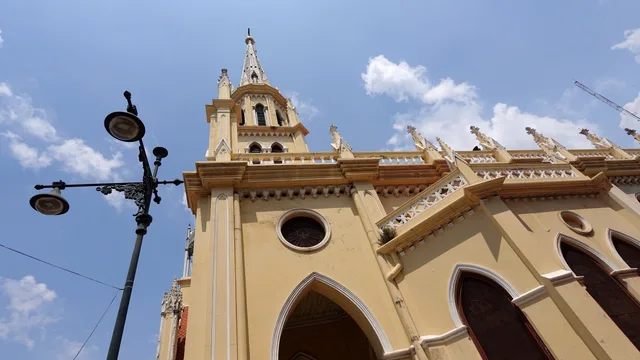
Holy Rosary Church
Samphanthawong · BangkokWelcome to Holy Rosary Church, in the Talat Noi district of Bangkok. It stands on the east bank of the Chao Phraya, the river that flows through the city. It is a Catholic parish church of the Archdiocese of Bangkok. It is one of the oldest churches in the capital.
This church has two names. Its official Thai name, Wat Mae Phra Luk Prakham, means "church of Our Lady of the Rosary". The word wat usually refers to a Buddhist monastery. Here, it names a Christian church. But local people call it Kalawar. This word is linked to the Portuguese Calvario, Calvary, the hill in Jerusalem where Christ was crucified. The Chinese neighbours have kept this nickname. It preserves a trace of the language of the first worshippers.
The story of this place begins with a community. In 1767, Ayutthaya, the former capital of the Kingdom of Siam, falls. In the years that follow, Portuguese Catholics settle in the area of present-day Talat Noi. The history of the church is traced back to their settlement, in 1769. According to tradition, these first worshippers had brought two revered images with them: an Our Lady of the Rosary and a figure of the dead Christ.
The church you see is the third built for this community. The second is blessed on the first of October 1839 by Monseigneur Jean-Baptiste Pallegoix. That day was then celebrated as the feast of Our Lady of the Rosary. It is on this occasion that the church receives the name it still officially bears. But this building does not last the century. In 1864, a great fire leads to the abandonment of the earlier church.
The new church is the work of a French priest, Father Desalles. He designs the building and directs the work himself, from 1891 to 1897. He chooses the Neo-Gothic style, which in the nineteenth century revives the forms of medieval European Gothic. On the ground, the plan forms a Latin cross: the nave is longer than the transverse arm.
Look at the façade, which faces the river. At its centre rises a tall bell tower. It is crowned with a spire, a slender pointed roof, and topped with a cross. It rises behind a high Gothic gable. The doorway is a pointed arch: two curves that meet in a point. This shape is repeated throughout the building, on the doors as well as the windows.
Inside, gilded arches give rhythm to the space. Large stained-glass windows let in the light. These coloured windows tell stories from the Bible. They are reputed to be among the finest in Thailand. Statues show the Virgin and Jesus giving the rosary to Saint Dominic and Saint Catherine. The rosary is a Catholic prayer. A sequence of Hail Marys is recited while meditating on the life of Christ and the Virgin, with a string of beads. This scene recalls to whom the church is dedicated.
Over time, the descendants of the Portuguese moved away. The church went through a period of decline. Other worshippers took over. Vietnamese and Cambodian Catholics, displaced by the Indochina wars, adopted the church, alongside Chinese immigrants. Together with the Chinese-speaking worshippers, they now make up a large part of the parish.
In the twentieth century, the church is restored several times: in 1957, for its sixtieth anniversary, then from 1983 to 1989, and finally in 1995. All these restorations sought to preserve the original architecture and decoration as far as possible. In 1987, the Association of Siamese Architects under Royal Patronage awards it its prize for architectural conservation, in the category of places of worship.
Holy Rosary Church is still an active parish today. Remember that it brings together a carefully preserved Neo-Gothic church and a living community, founded by Portuguese worshippers and carried on today by Catholics of many different origins.
Photo : © Eric Monteil
Source: JARUK