
Bangkokian Museum
Bang Rak · BangkokWelcome to the Bangkokian Museum, in the Bang Rak district of Bangkok. This house museum tells the story of neither the royal court nor the capital's great monuments. Instead, it opens up the home of a family of city dwellers to you. Its Thai name, Phiphithaphan Chao Bang Kok, literally means "museum of the people of Bangkok".
Here, you discover the daily life of Bangkok's comfortable middle class, during and after the Second World War. You see how they furnished their homes, entertained, cooked and kept their memories. This is not a reconstruction of one particular year. It is a house as it was lived in, then passed down, with the objects gathered over time.
The museum stands on a plot of about one thousand seven hundred square metres, near Charoen Krung Road. Three houses are set out in a tropical garden, around a pond.
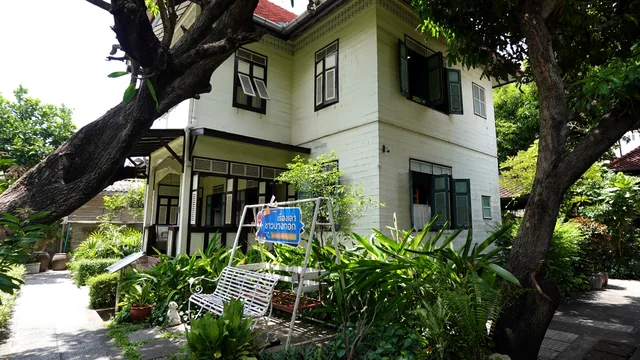
The main house is built in 1937 for the Suravadi family. It is a two-storey teak residence, painted white, with Western influences. Its hipped roof has four sloping sides. Its seven rooms have kept the state they were in more than eighty years ago. Most of the objects have stayed in their places, just as they were in the lifetime of Sa-ang, the mother of the family. So the setting you see is not a reconstruction. It belongs to a family who really lived here.
On the ground floor, you enter a sitting room where the piano was often played. Next comes the dining room. The table stands on legs shaped like lion's paws. The chair backs are carved with knots and bouquets, in the Western manner. Notice too the original louvred shutters, the four-poster beds and the upright piano. These rooms show how a well-off Bangkok family takes up European forms and customs in the nineteen-thirties. A reconstruction of a wartime Bangkok kitchen completes the tour.
The oldest house has a different story. In 1929, Sa-ang has it built at Thung Maha Mek, in Ngam Duphli Lane, for her first husband, Doctor Francis Christian. This doctor studied surgery in England. The ground floor is meant to house his surgery, and the upper floor to serve as living quarters. But the doctor dies before he can move in. Later, the house is taken apart, then rebuilt here on a smaller scale, for lack of space. Accounts differ on how much of the original material was kept. Inside, you see medical textbooks, medical instruments, diplomas and old photographs. They recall a surgery the doctor never used.
The museum owes its existence to Waraporn Surawadee, Sa-ang's daughter. An associate professor and a biologist by training, she inherits the land and the houses. She turns them into a private museum, a centre for learning about the history of Bangkok. She welcomes visitors herself and acts as their guide. Then, on the first of October 2004, she gives the property to the Bangkok Metropolitan Administration. One volunteer summed up this gesture by saying she had "given the house to the Thai people".
Since then, the Bang Rak District Office has run the site, which also serves as the district's local museum. On the upper floor of the third building, an exhibition presents the history of the people of Bang Rak, in nine themes. The garden also has a sala, an open pavilion where people can shelter and rest.
Waraporn Surawadee dies in January 2017, at the age of eighty. The city continues to run the museum, and admission remains free.
Remember this: the Bangkokian Museum is neither a palace nor a religious monument, but a family home still inhabited by its objects. It is a private residence turned public place, telling the story of both a family and a neighbourhood.
Photo : © Eric Monteil
Source: JARUK