
Wat Chak Daeng
Phra Pradaeng · Samut PrakanWelcome to Wat Chak Daeng, a Buddhist monastery in Phra Pradaeng, in Samut Prakan province. You are on the banks of the Chao Phraya, in the still-green loop of Bang Krachao.
Bang Krachao is a vast meander that the river almost entirely encircles. The area has stayed green: coconut groves surround the monastery, and a canal, the Khlong Chak Daeng, runs along the western side of the grounds.
The temple was founded around 1782. It is a community temple, a wat rat, literally a "people's temple", and not a royal temple. Its name may preserve the trace of a movement of people. "Chak Daeng" is said to come from a Thai expression meaning "come from another land". It may have referred to a village of people who came from Ayutthaya, the former capital. But this etymology remains a supposition.
The monastery keeps an old statue of the Buddha, Luang Pho Hin. The title Luang Pho, "venerable father", is given to the most revered images in a temple. This one was unearthed near the old ubosot.
The ubosot is the ordination hall. The present one dates from 1858. It was restored in 1961. Its pediment is decorated with blue-and-white porcelain. Inside are the monastery's principal Buddha image and murals. They tell the life of the Buddha. A few scenes show hell, where figures suffer the consequences of their bad deeds. Higher up the walls, other paintings celebrate the most sacred stupas of Thailand and neighbouring countries.
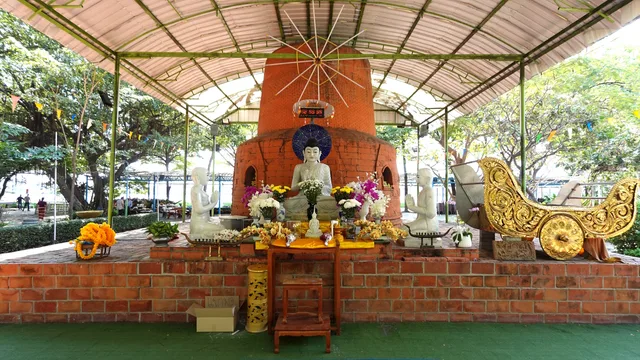
Near the river stands a circular brick chedi. It reproduces the Dhamek Stupa at Sarnath, in India. According to tradition, this is where the Buddha gave his first sermon. Its massive, cylindrical shape contrasts with the bell-shaped chedis that are more usual in Thailand. A second stupa, in a modern style, overlooks the river. At the top of its four storeys, a hall houses a replica of the Buddha of the Mahabodhi Temple at Bodh Gaya, where, according to tradition, the Buddha attained Enlightenment.
Parallel to the ubosot, the sala kan parian is the hall where people listen to sermons. It houses a large golden statue of the Buddha. It is a replica of the Phra Phuttha Chinnarat, the emblematic image of Phitsanulok. Its wooden floor makes it a place for contemplation and meditation.
But Wat Chak Daeng owes its reputation above all to study. Pali, the language of the canonical texts, is taught here intensively. It is also a school of Abhidhamma, the part of the Buddhist canon devoted to the analysis of the mind and of phenomena. Teaching is open to monks and novices, but also to lay people, who attend classes at weekends. In October 2015, the monastery was designated an "exemplary school of religious studies". Its major programme on the Tipitaka, the Buddhist canon, draws attention beyond Thailand: a delegation of Sri Lankan monks came to learn about it.
Study goes hand in hand with practice. The temple holds retreats and meditation sessions during the major Buddhist festivals, such as Magha Puja, Visakha Puja and Asalha Puja. In October 2024, the community numbered around sixty-eight Thai monks and novices, and about ten elders from abroad.
The monastery is also known for its plastic waste recycling programme, which turns bottles, among other things, into monks' robes. A community pavilion, completed in 2022, hosts religious ceremonies, but also weddings and funerals.
Remember this: Wat Chak Daeng is a neighbourhood temple born in the late eighteenth century, which has become a recognised school of Pali and the Buddhist canon, and which brings the great sites of Buddhist India to the banks of the Chao Phraya.
Photo : © Eric Monteil
Source: JARUK