
Wat Paket
Phra Pradaeng · Samut PrakanWelcome to Wat Paket, a Theravāda Buddhist monastery in Bang Krachao. This great wooded bend of the Chao Phraya faces Bangkok, in the province of Samut Prakan. The temple is still in use. It is the monastery of a village community, that of Ban Mai Song Khanong. In the same lane lies this community's forest park. It is said to be the first urban community forest in Thailand.
The monastery was first called Wat Thanon Ket, "the temple of Ket's road". According to a local tradition, the name comes from Ta Ket, "Grandfather Ket". This villager is said to have been the first to open the road leading to the temple. The name later became Wat Paket.
The founding of the temple is linked to the reign of Rama II, the second sovereign of the Chakri dynasty, who reigned from 1809 to 1824. This king led a movement to restore Buddhism throughout the kingdom. Wat Paket is one of his foundations. The villagers place its founding around 1817, a date handed down by oral tradition.
Under the next reign, that of Rama III, the monastery receives its ubosot, the hall where ordinations take place. Its construction is attributed to the Supreme Patriarch Don, head of the kingdom's monastic community. He lived at Wat Mahathat Yuwaratrangsarit, in Bangkok. Local memory goes further: it makes him the founder of the temple itself. In both versions, this village monastery remains linked to one of the highest religious dignitaries of the capital.
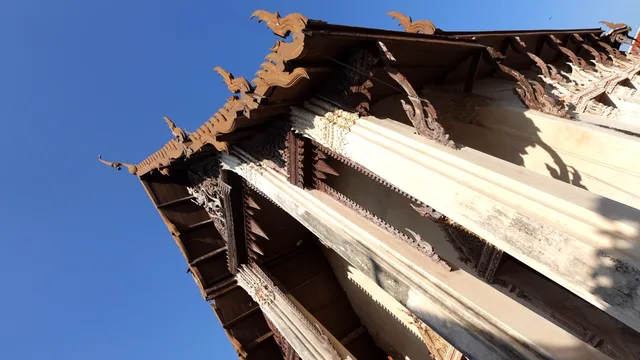
This old ubosot belongs to early Rattanakosin art, the period that began when Bangkok was founded as the capital. On its front and rear façades stand large square pillars. Their shafts taper towards the top. Now look up at the pediment, the triangular panel that closes the gable of the roof. It is made of carved teak. It shows Narai, the Thai name for the god Vishnu, riding on Garuda, the mythical bird that serves as his mount. Garuda grasps nāga, the divine serpents of Indian mythology. All around unfolds scrolling foliage, made of curling, leafy stems.
Inside, the walls are covered with paintings. They are attributed to the craftsmen of the Chang Sip Mu, the corps of the "ten crafts" in the service of the court. Here you see the Victory over Māra: on the night of his Awakening, the future Buddha drives back Māra, the figure of temptation and death. You also see the Buddha's descent from the Tāvatiṃsa heaven, the paradise of the Thirty-Three gods. The Thotsachat tells the last ten previous lives of the Buddha. An assembly of deities completes the whole.
In 1970, a new ubosot is built for ordinations. It houses a large principal statue of the Buddha. The old building is not abandoned: since then it has served as a vihara, a hall that welcomes the faithful for prayer and ceremonies.
The temple also has a vihara dedicated to Luang Pho To, the "venerable father". He is a large seated Buddha, in the posture of victory over Māra. His right hand rests pointing towards the earth, calling it to witness his Awakening. The villagers hold him in particular devotion.
Around the halls of worship live the monks, in traditional teak houses. The temple also has a recitation hall decorated with paintings, a scripture library and a sermon hall built in 1982. Here, people are ordained, they pray, they listen to sermons, they accompany the dead.
Remember this: Wat Paket is a village temple, linked by its history to the heart of the kingdom. Its old ubosot, with its pediment of Narai on Garuda and its paintings attributed to the craftsmen of the court, is the physical witness to that link.
Photo : © Eric Monteil
Source: JARUK