
Bang Nam Phueng Floating Market
Phra Pradaeng · Samut PrakanWelcome to Bang Nam Phueng Floating Market. This community market lies in the subdistrict of Bang Nam Phueng, in Samut Prakan province, at the heart of the green space of Bang Kachao, on the doorstep of Bangkok. It opens at weekends. It was born of a decision taken by the local residents.
Bang Kachao occupies a bend in the Chao Phraya River, opposite Bangkok. Its residents nickname it "Krapho Mu", the pig's stomach. Here, the fresh water of the river meets salt water. Bang Nam Phueng is an orchard community. A canal of about one and a half kilometres runs through it and joins the river. It irrigates the land and makes the soil fertile.
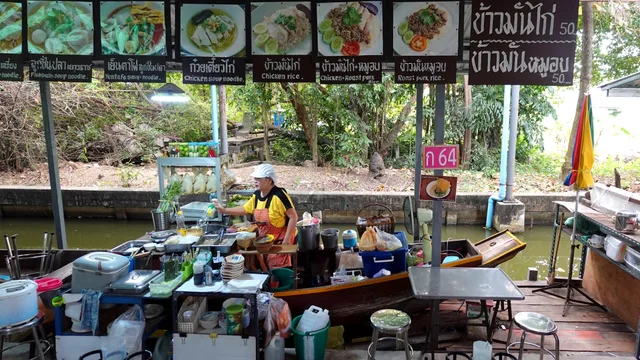
The name of the subdistrict brings together water and sweetness. "Bang" means a settlement by the water, and "nam phueng" means "honey". Yet the origin of this name remains unknown. The word "floating" also calls for a word of explanation. Here, trade takes place mostly on the bank, along a covered walkway. The canal serves as a setting and as a route for a stroll.
This market is not the heir to an old canal market. Faced with unemployment, the residents drew up an action plan together. The first step was not trade, but the garden. Each household received seedlings of vegetables and fruit trees. The market came afterwards, to sell this produce and bring an income to families. It opened on the twenty-eighth of February two thousand and four, with financial support from the Provincial Administrative Organisation. It has no identified founder: it is the collective work of the residents.
The covered walkway stretches for more than two kilometres. It follows small canals that branch off from the river and reach into the farmland. You walk between the water and the stalls, sheltered from the sun and the rain. The vendors come from Bang Nam Phueng and from neighbouring subdistricts.
On the stalls, fruit from the gardens takes pride of place. You can see green coconuts, nam dok mai mangoes and strongly scented hom bananas. There are also chomphu mamiao, small, crunchy red fruits. Local sweets play an important part. Khanom thuai are little coconut cream custards. Khanom chak are a paste of sticky rice and coconut, grilled in a palm leaf. Kalamae is a confection of coconut and palm sugar. Mi krop, fried and caramelised rice vermicelli, is made in the traditional way. On the savoury side, kuai tiao lui suan is a soup whose name means "orchard noodles". The market also sells OTOP products, from the national "One Tambon, One Product" programme.
From two thousand and seven, the market became the starting point for tourism centred on discovering the local way of life. At nightfall, visitors go out by boat to watch the fireflies along the riverbanks. The residents also offer rowing boats, bicycles for exploring the orchards, traditional massage and homestays.
During the Covid-19 epidemic, the market closed. It reopened at the beginning of October two thousand and twenty-one. It follows the rhythm of Saturdays, Sundays and public holidays. During the week, the walkway becomes a residential neighbourhood once again.
The market has no heritage listing of its own. But it depends on the fate of Bang Kachao, often called the "green lung" of Bangkok. A three-year programme renovated the public green spaces and protected a large part of the island from urban development. Its orchards and canals are what give the market its value.
Remember this: this market is not an ancient relic. It is the recent choice of an orchard community, linking cultivated land, family cooking and the welcoming of visitors, at the heart of one of the last great green spaces on the doorstep of Bangkok.
Photo : © Eric Monteil
Source: JARUK