
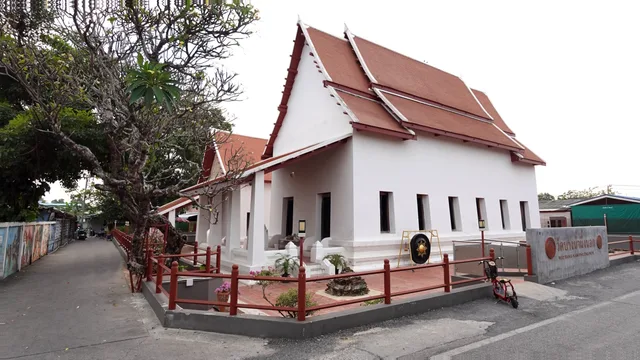
Old Ordination Hall of Wat Bang Nam Phueng Nok
Phra Pradaeng · Samut PrakanWelcome to Bot Kao Wat Bang Nam Phueng Nok (Old Ordination Hall), the former ordination hall of the monastery of Bang Nam Phueng Nok. You are in the Bang Krachao loop, on the bank of the Chao Phraya River, in Samut Prakan Province. Here the river traces a vast meander that has stayed largely green. It is nicknamed the "green lung".
This building is an ubosot. It is the most sacred hall of a Buddhist monastery. Only this hall can host the ordination of monks, because its ground is consecrated and marked out by boundary stones. Together with the old vihan next door, the assembly hall for the faithful, it forms a group apart. These two buildings keep the memory of an earlier monastery.
Why do they stand apart? Because the monastery was moved closer to the riverbank. Luang Pho Saiyut, abbot from 1961, had a new ubosot built there. On the sixteenth of March 1966, its consecrated ground received the royal grant. Queen Rambai Barni, widow of King Prajadhipok, then cut the cord of the luk nimit, the stone spheres that mark the sacred boundaries. Since then, ordinations have taken place by the river. The old ubosot and the old vihan, however, have remained where the temple was first founded. The word kao, in the name, means "old".
No one knows when or by whom the monastery was founded. The architecture serves as the guide. It points to construction at the end of the Ayutthaya period, around the last third of the seventeenth century. For the old ubosot, two theories coexist: the late Ayutthaya period, or the early Rattanakosin period, after the capital moved to Bangkok. Its paintings, for their part, are attributed to the early Rattanakosin period. So see in this building the work of a transitional age.
Look at its outline. The walls are made of brick covered with render. The gable walls, the triangular walls at each end, rise in brick right up to the ridge, beneath a roof that overhangs them. This type of construction is called kra-thae-soe. It is also known as "Dutch" style. If you know the temples of Bangkok, you will see the difference. Here, there is no decorated pediment framed by roof ornaments. The masonry rises in a single piece, and the outline stays massive and plain. This type has become rare, and two neighbouring buildings preserve it here.
Inside the ubosot, the principal image is a large Buddha in meditation. He is seated, with his hands resting one upon the other in his lap. The faithful call him Luang Pho Yai, the "great venerable father". The hall's mural paintings have almost entirely faded. But the door and window panels have kept their decoration. They are painted in tempera, a water-based paint applied to the wood, and depict deities, among other subjects. Together with Luang Pho Yai, they are the most precious feature of the hall.
The old vihan next door has a roof in a single piece, with no curved ridge finial. Its pediment, modelled in stucco, shows Narai, the Thai name for the god Vishnu, depicted with two arms and surrounded by peonies and foliage.
For decades, the two buildings stood abandoned. The humid climate wore away the render and faded the paintings. The old ubosot was registered as an ancient monument by the Fine Arts Department, which places it under state protection. In 2017, the department restored the old ubosot and the old vihan. A consecration ceremony marked the end of the work. Among other things, medals bearing the image of Luang Pho Yai were consecrated. For the community, this place has never ceased to be sacred.
Remember this: this old ordination hall is the heart of an earlier monastery, left in place when the community moved closer to the river. It bears witness to a transitional age between Ayutthaya and Rattanakosin, and it remains a place of devotion centred on Luang Pho Yai.
Photo : © Eric Monteil
Source: JARUK