
Mahadevalai Ganesha
Phra Pradaeng · Samut PrakanWelcome to the Mahadevalai Ganesha, a Hindu shrine dedicated to Ganesha, the elephant-headed deity whom Thai people call Phra Phikhanet.
You are on the Bang Kachao peninsula, in a wide bend of the Chao Phraya River, very close to Bangkok. This bend is nicknamed ‘the pig’s stomach’ because of its shape. It is an area that has stayed very green, known for its walks and its scenery. The shrine stands not far from the Bang Nam Phueng floating market.
This place is neither a Buddhist monastery nor an ancient temple. It is a thewalai, which means a dwelling of the gods. Here, Brahmins, priests responsible for leading the rites, officiate for the worshippers. People come here to pray to Hindu gods. There is no community of monks.
The shrine is very recent. It was founded around the beginning of the twenty-tens. So its history is counted in years, not in centuries. It owes its existence to a single person, Ajarn Be Ommastra. Ajarn is a Thai title given to a master or a teacher. Ajarn Be Ommastra presents themselves as a spiritual guide. This person says they built the place with their own resources, and places Ganesha at the origin of their faith. So the shrine was born of a personal conviction, not of a religious institution.
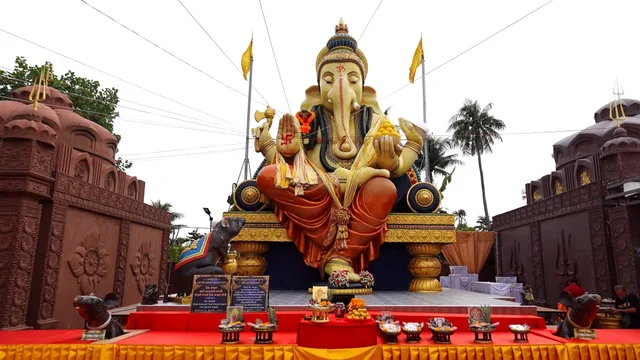
The heart of the place is the great statue of Ganesha. It stands about nine metres tall, roughly the height of a three-storey building. It dominates the site. Ganesha is seated here in a posture called ‘pang maharacha’. The word ‘pang’ refers to the attitude of a deity, and ‘maharacha’ means ‘great king’. The shrine presents this statue as the first in the world, and the only one in Thailand, in this posture. That is how the place describes itself. Above all, it shows the importance given to this royal posture.
Ganesha is not alone. The shrine also honours Shiva, called Phra Siwa in Thai, and Uma, his consort in the Hindu tradition. It also honours Thao Wetsuwan, one of the guardians of the world in Buddhist cosmology. And two nāga, serpent deities: Chao Pu Si Suttho and Chao Ya Si Pathumma. These figures are already familiar in Thai popular devotion. They have also changed over time, because the shrine is still being developed.
Why do people come here? To ask for success, career advancement and wealth. The place is part of a phenomenon that Thai people call ‘sai mu’ or ‘mutelu’. It is a form of devotion centred on luck. It leads many worshippers to places thought to favour their plans. Ganesha holds a special place in it.
The main rite is called ‘phithi lot tai phra chong’. It involves passing beneath the legs of the statue of Ganesha. A Brahmin leads it, following a precise sequence. On the first pass, the worshipper holds their breath. They entrust the deity with their sorrows, and with whatever they wish to leave behind. On the second pass, they breathe normally and make a single wish. Just one, because according to a belief passed on here, asking for more would be seen as greed. And the deity would not reward it. So the gesture combines two movements: letting go of a burden, then expressing a hope.
Prayer goes together with offerings. The worshipper chooses a set suited to their wish. They can then take it home for worship in the household. In this way, devotion continues at home.
In just a few years, the shrine has become one of the spiritual landmarks of Phra Pradaeng district. The press writes about it, and visitors share their visits on social media. Some come to make a wish. Others discover the place during a walk around the bend of the river.
Remember this: the Mahadevalai Ganesha is not an ancient monument, but it shows the Thailand of today, where people turn to Hindu gods for success and wealth, through a simple gesture: passing beneath a statue, laying down their sorrows, then making a single wish.
Photo : © Eric Monteil
Source: JARUK