
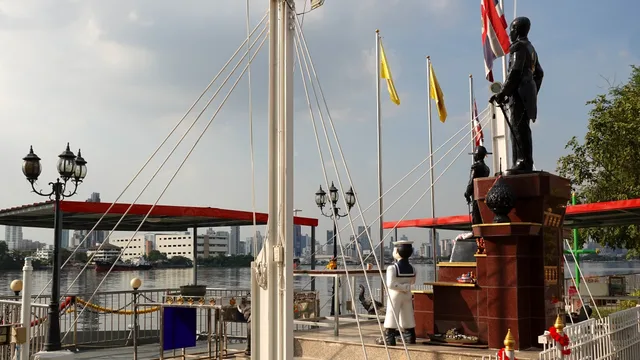
Prince of Chumphon Memorial
Phra Pradaeng · Samut PrakanWelcome to the Prince of Chumphon Memorial (Father of Thai Navy). You are in Bang Yo, near the Wat Bang Krachao Nok pier, on the banks of the Chao Phraya. This monument honours Prince Abhakara Kiartivongse, a son of King Chulalongkorn. He was the driving force behind the modernisation of the Siamese navy.
Bang Yo is a subdistrict of Phra Pradaeng district, in Samut Prakan province. It covers part of Khung Bang Kachao, the great loop the river forms here. Boats link this bank with the Bangkok side. The Wat Bang Krachao Nok pier is one of their landing points. It is here, at this crossing point between the city and the loop, that the prince's memory has found its place.
The temple that gives the pier its name was founded around 1910. Its founder is unknown. It stands at the mouth of the Bang Krachao khlong. In Thailand, a khlong is a canal or a minor waterway. In fact, local people call this temple Wat Pak Khlong Bang Krachao: the temple at the mouth of the khlong.
Let us return to the prince. He was born on 19 December 1880. He was the twenty-eighth child of King Chulalongkorn, Rama the Fifth. His full Thai title is long. Common usage has kept a shortened form, Krom Luang Chumphon, which translates as Prince of Chumphon. This is the name by which collective memory most often knows him. At the end of 1893, his father sent him to study abroad, together with one of his brothers.
Back in Siam, the prince joined the Royal Navy. He played a significant part in modernising it. He became its minister, succeeding Prince Bhanurangsi Savangwongse, whose daughter he had married. His career reached its peak when he was honoured as commander-in-chief, admiral and father of the Siamese navy. But shortly afterwards, ill health forced him to resign.
In retirement, he sought treatment at Hat Sai Ri, a beach in Chumphon province. It was in Chumphon that he died, on 19 May 1923, at the age of forty-two. This place and this date became the two anchors of his memory.
The Royal Thai Navy made 19 May an annual day of remembrance bearing his name. In 1993, it officially gave him the title of Father of the Thai Navy. This recognition secured his place in national history: that of the founder of the modern navy.
Alongside this official tribute, another kind of memory has grown. Many Thais call the prince by an affectionate nickname: Sadet Tia. He is among the members of the royal family who have been raised to the status of sacred figures. Shrines are dedicated to him throughout the country. Some come with stories of miracles.
In Bangkok, in the Nang Loeng district, a former Chinese shrine next to his palace was dedicated to him after his death. People came there to collect holy water against illness and to make wishes. His most famous shrine, however, is at Hat Sai Ri, where he sought treatment. On a hill north of the beach stands a memorial pavilion. In Pattaya, a bronze statue depicts him.
Recent shrines often give him a specific role: protecting sailors. In 2014, for example, a municipality in Phetchaburi province completed a shrine at the mouth of a river, to protect shipping and to support tourism. The memorial where you are standing belongs to this wider picture, which ranges from great historic shrines to neighbourhood tributes.
Today, the pier is a very busy crossing point. The ferries bring visitors, often cyclists, to the green spaces of the loop, such as Sri Nakhon Khuean Khan Park. The memorial therefore lies along their route.
Remember this: the Prince of Chumphon modernised the Siamese navy before dying young, in 1923. His memory follows two paths that meet. The institution proclaimed him Father of the Thai Navy and honours him every 19 May. Popular devotion turned him into Sadet Tia, a sacred figure who protects those who sail. Here, at the pier of a village temple, on the banks of the river, you can see how a national figure takes root in an everyday landscape.
Photo : © Eric Monteil
Source: JARUK