
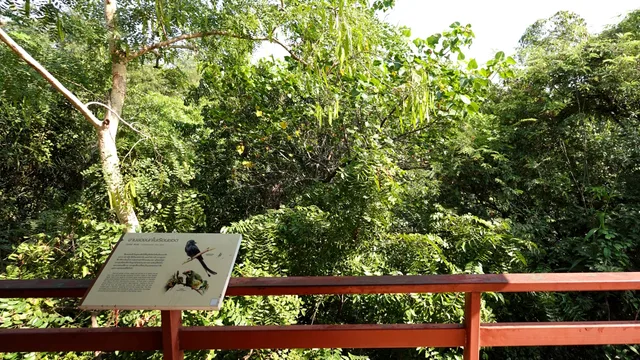
Si Nakhon Khuean Khan Bird Tower
Phra Pradaeng · Samut PrakanWelcome to Si Nakhon Khuean Khan Park's Bird Watching Tower, in Bang Kachao, in Samut Prakan province. In Thai, it is simply called hor du nok: the tower for watching birds. The name says everything about its purpose. It is neither a monument nor a pleasure pavilion. It is a platform about seven metres high, designed to lift you up to the level of the treetops.
Its importance lies in the place it lets you see. Bang Kachao is a loop of the Chao Phraya River. Here the river cuts off a peninsula of about twenty-four square kilometres, surrounded on all sides by the Bangkok metropolitan area. Yet forest and farmland still cover most of the land. This area is the last remnant of the green belt that once encircled Bangkok. It is often called the green lung of the capital. For much of the year, its vegetation supplies the city with fresh air, carried by the seasonal winds.
This park was born of a wish to preserve the loop. King Bhumibol had expressed the wish that the island be preserved. Following this wish, the State bought abandoned plots of farmland. Only a small part, around twenty-four hectares, became the park. Its name was granted by the King. It means "public park that is the glory of Nakhon Khuean Khan". The park is not an isolated initiative: it grew out of a conservation programme launched in 1991.
The path to the tower crosses two landscapes. At the entrance lies a landscaped park, with lawns, flower beds, a large pond and waterside pavilions. Further on, the scenery changes. You enter former orchards, whose ditches have been kept. These ditches are called thong rong, and wooden footbridges cross them. Coconut groves and areca palms also recall the old orchard. The park does not erase the history of this land: it shows it.
Water shapes the whole park. Islets, ponds, canals and a large lake form a wetland, one of the characteristic habitats of Bang Kachao. The botanical garden has more than a hundred plant species. Since 2013, a forest of about six hectares has been recreated here, to bring together the ecosystems of the loop in a single place.
Once at the top, you look out over the canopy, that is, the upper layer of the trees. Regulations forbid high-rise buildings here. So no building seems to rise above the trees. And yet the city surrounds the loop on all its banks.
What you come here to do is simple: climb, wait, and watch. More than a hundred bird species, resident or migratory, visit the park. You may see the little egret, the common myna, bulbuls or the pink-necked green pigeon. In winter, other visitors arrive, such as the peregrine falcon, the Asian paradise flycatcher or the ashy drongo. Most of these species are protected by Thai law.
Birds are only part of the wildlife. The marshes and canals are also home to reptiles, such as the Malayan water monitor and the reticulated python, and to many fish, including the archerfish. For all these animals, the park is a place to feed, to breed and to find shelter.
The park is also a place for a stroll. Entry is free; people walk and cycle here, and schools organise outings. Since 2019, the whole of Bang Kachao has been designated a protected area, a status that nonetheless remains debated.
Remember this: this tower is above all a tool for looking. It reveals a fragment of Bangkok's green belt, still alive in the middle of the city.
Photo : © Eric Monteil
Source: JARUK