
Sri Nakhon Khuean Khan Park
Phra Pradaeng · Samut PrakanWelcome to Sri Nakhon Khuean Khan Park and Botanical Garden. You are in the north of Bang Kachao, a peninsula in Samut Prakan Province. Just opposite, on the other bank, lies Bangkok.
Local people call this peninsula Krapho Mu, "the pig's stomach", because of its shape. It is also nicknamed the "green lung" of Bangkok. It is the last remnant of the green belt that once surrounded the capital. But this is not untouched nature. More than thirteen thousand families live here.
The park grew out of this situation. In 1977, the Council of Ministers designates Bang Kachao as a protected green area. The aim is to save this farmland from urban development. The project moves slowly. It is only approved in 1991. Since compulsory purchase has not succeeded, the State chooses another approach: it invites residents to sell their land voluntarily. The park is laid out on a hundred and forty-eight rai of this purchased land. The rai is the Thai unit for measuring farmland.
Its name was given by King Bhumibol Adulyadej, known as Rama the Ninth. Today, the park is managed by the Royal Forest Department. Admission is free.
The site has two roles. It is a public park, where people relax, go for walks and take exercise. It is also a botanical garden, which displays plants and protects natural habitats.
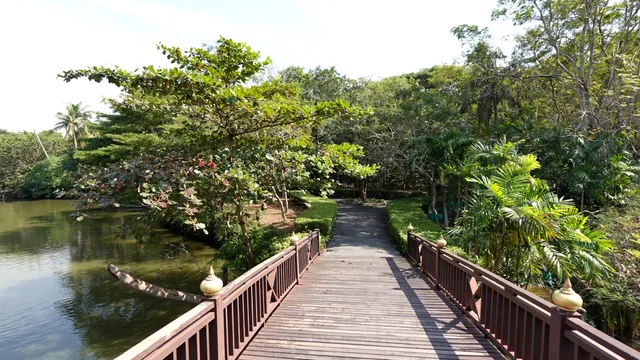
The front section is a landscaped garden. Here you find lawns, flower beds and ornamental plants, set around a large pond. At the water's edge stand sala. These are open pavilions, where people shelter from the sun and the rain. An exhibition building tells the story of the site. It reminds visitors that this garden was not created from scratch.
The inner section keeps the layout of the old orchards. Here you find the thong rong: raised beds of earth, separated by ditches. Wooden walkways on stilts cross this network. In this way, you rediscover the landscape of Bang Kachao as it was before the park existed. A demonstration farming area preserves a coconut grove and a plantation of areca palms, inherited from the old orchard.
Further on, the park protects wetlands and a restored forest. Princess Maha Chakri Sirindhorn has visited the site four times. She asked for the park to be made useful for educating young people, along the lines of a "nature classroom". She also wished to involve the villagers, to ban the felling of large trees and to encourage fruit trees. From 2013, a forest plot of around forty rai is restored. Pupils learn there through direct contact with the habitats themselves. The results can be seen. The number of plant species rises from about ninety in 2014 to more than a hundred and ten in 2017. More than a hundred native animal species have also been recorded.
These ponds, ditches and woodlands are home to varied wildlife. The park is popular with birdwatchers. An observation tower has been built here. Cyclists touring Bang Kachao make it one of their favourite stops. And a market selling community products is held within the site.
Yet the future of this landscape remains fragile. On the peninsula, rising land prices are pushing some owners to sell or to build. The State is trying to protect it, through tax exemptions and an ecotourism project.
Remember this: this garden is not wild nature kept under glass. It is an old landscape of orchards, bought back from local people to save the last great green space on the outskirts of Bangkok.
Photo : © Eric Monteil
Source: JARUK