
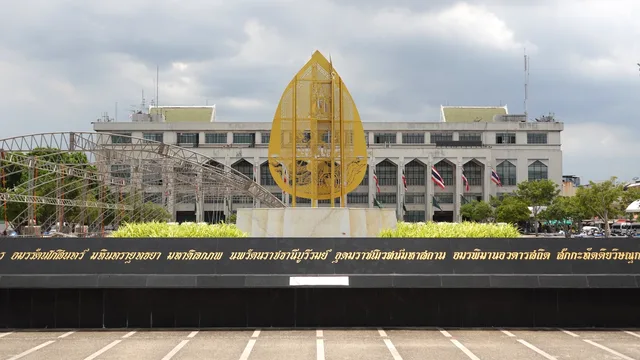
Bangkok City Hall
Phra Nakhon · BangkokWelcome to the Bangkok Metropolitan Administration City Hall, the first city hall of the Thai capital. It stands in the historic district of Phra Nakhon, the old heart of Bangkok. Its façade looks directly onto the Giant Swing. Also opposite is Wat Suthat Thepwararam, a Buddhist monastery.
Before it was built, the site was a vast field of beaten earth, where the Sao Chingcha market was held. The Bangkok municipality moved here in 1941, at first into old shophouses. The land is part of the Crown's property. To build, the municipality had to buy it, with royal consent.
In the mid-1950s, the mayor, General Mangkon Phromyothi, judged the premises too cramped. He entrusted the project to Mom Chao Samai Chaloem Kridakorn, an architect at the Fine Arts Department. The foundation stone was laid on the twenty-fourth of June 1956. Construction then went ahead in phases, over several decades. A lookout tower was planned, but work on it was halted. Some architects regretted this. Others were glad that it would not overpower the Giant Swing.
The building belongs to the so-called Applied Thai style. This style carries traditional Thai forms over onto a modern building. Look at the triangular window frames. They have been compared with the roof of the nearby Wat Suthat Thepwararam. This is one interpretation, not an intention recorded by the architect. But it shows how the building converses with its surroundings.
The plan is symmetrical. The office wings form a quadrangle around a central courtyard. The building has three storeys, designed for the tropical climate. Wide galleries shield the façades from sun and rain. A large open hall lets the air circulate. A tall colonnade gives the whole its rhythm, as on a prestigious public building. The council chamber stands out for its high, broad roof.
On the fifteenth of December 1972, the municipalities of Bangkok and Thonburi merged. The building became the seat of the Bangkok Metropolitan Administration. Designed for a municipality, it became the seat of a metropolis.
In front of the building, a black stone stele bears the full official name of the capital. This ceremonial name is recognised as the longest city name in the world. The stele was erected in 2002, for the two hundred and twentieth anniversary of Rattanakosin. In front of the city hall there is also a large esplanade, Lan Khon Mueang, the city dwellers' square.
Today, its role as headquarters is moving to a second city hall, in Din Daeng. The Sao Chingcha site is to become a city museum. In the meantime, the esplanade already hosts cultural events, such as Bangkok Design Week.
Remember this: this city hall gave Bangkok's modern administration an architecture drawn from Thai tradition. After decades of government, it is now set to become a witness to the city's history.
Photo : © Eric Monteil
Source: JARUK