
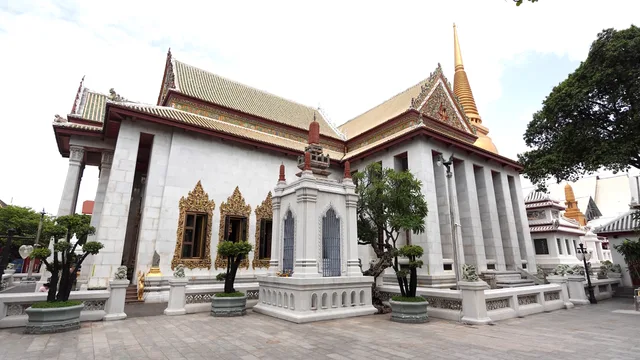
Wat Bowonniwet Vihara
Phra Nakhon · BangkokWelcome to Wat Bowonniwet Vihara, a royal Buddhist monastery in Bangkok. It is also known, more simply, as Wat Bowon. It is the home of the Thammayut order, a movement of monastic reform that arose within Theravada Buddhism.
The monastery was born during the reign of King Rama the Third. It was founded by the viceroy of that reign, who held the title of Wang Na, the "Front Palace". Its first name was very simple: Wat Mai, the "new temple". Its present name comes from Pali. The community translates it as "monastery of the Excellent Abode".
In eighteen twenty-nine, the viceroy brought a bronze statue of the Buddha from Phitsanulok. It is called Phra Phuttha Chinnasi. It is the monastery's principal statue. It stands in the ubosot, the hall where monks are ordained. According to tradition, it belongs to a group of three famous images.
In eighteen thirty-six, everything changed. Prince Mongkut settled here as a monk. King Rama the Third asked him to lead the monastery. Mongkut led it for fourteen years. Then he came to the throne in eighteen fifty-one, as Rama the Fourth. Three years before his arrival, he had founded the Thammayut order. Here, the movement found a place and a community.
Mongkut gave great importance to study and to the written word. Within the grounds, he had a building put up where he installed a printing press. This small residence still bears the name "Printing House". Later, in eighteen ninety-three, King Chulalongkorn and Prince Vajirañāṇavarorasa founded a school here, open to monks and lay people alike.
Inside the ubosot, look up. The walls bear paintings attributed to Khrua In Khong, a monk and painter. They date from around eighteen forty. This painter is regarded as the first Thai artist to apply perspective and light and shade to mural painting, techniques that came from the West. His paintings do not tell the past lives of the Buddha, as you might expect in a temple. High on the walls, sixteen panels show Western figures. They are "riddles of the Dhamma", images to be deciphered. Their subject is the virtue of the Three Jewels: the Buddha, his teaching and the community of monks. So you do not follow a story from panel to panel. You interpret scenes.
Today's monastery brings together two former foundations, once separated by a canal: Wat Mai to the north, and Wat Rangsi Sutthawat to the south. They were joined during the reign of King Vajiravudh, Rama the Sixth. Here you can make out the ubosot, a golden chedi, which is a reliquary monument, and the areas where the monks live.
After Mongkut, several abbots became Supreme Patriarch, that is, head of the kingdom's Buddhist clergy. The monastery also holds a special place for the Chakri dynasty. According to a custom regarded as traditional, princes are ordained at Wat Phra Kaew, then spend fifteen days here as monks. King Bhumibol followed this path in nineteen fifty-six. The present king, Rama the Tenth, followed it in turn in nineteen seventy-eight.
Finally, the monastery is a place of royal burial. The ashes of King Vajiravudh and those of King Bhumibol are enshrined in the base of the principal statue, Phra Phuttha Chinnasi. Since Bhumibol's ashes were placed here, in two thousand and seventeen, the faithful have flocked here to pay their respects.
Remember this: founded by a viceroy and transformed by a prince who was a monk, Wat Bowonniwet Vihara is both the home of a religious reform and a place of royal remembrance.
Photo : © Eric Monteil
Source: JARUK