
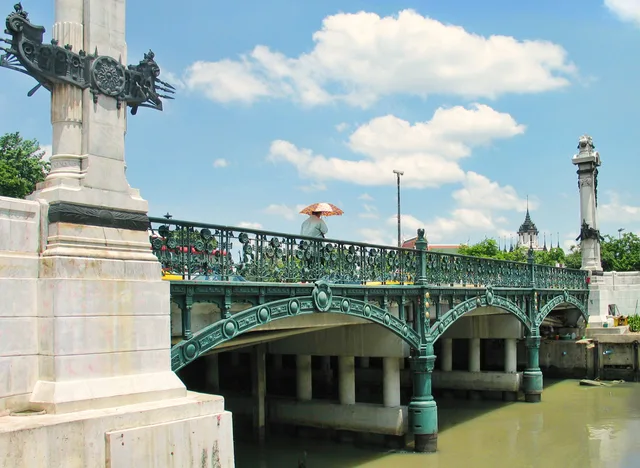
Phan Fa Lilat Bridge
Phra Nakhon · BangkokWelcome to Phan Fa Lilat Bridge, in Bangkok. This bridge carries Ratchadamnoen Avenue, the capital's great ceremonial road, over the canal that encircles the old city.
This canal is the Khlong Bang Lamphu. In Thai, the word khlong means a canal. This one forms a section of the old city's outer moat. So the bridge stands on the edge of Rattanakosin Island, the historic heart of Bangkok. To cross it is to leave the old city for the districts beyond its moat. At the foot of the bridge stands Mahakan Fort. It is one of the fourteen forts built in the reign of King Rama the First, and one of the two that still survive in Bangkok.
The bridge is tied to a grand project. King Chulalongkorn, also known as Rama the Fifth, wants a ceremonial axis for his capital. Work on cutting Ratchadamnoen Avenue begins in 1899. An old iron arch bridge already crossed the canal at this spot. The king has it rebuilt, to make it large and beautiful, worthy of the avenue it is to carry. The exact year of this construction is not known. The work was never announced in the Royal Gazette.
It is the king himself who names the bridge. Saphan Phan Fa Lilat translates as "the bridge where the king passes through the heavens". The name evokes the majestic progress of the sovereign. Before it was a road, the bridge was part of the setting for a route designed for the king's passage. In everyday speech, people simply say "Phan Fa Bridge".
Now look at the decoration. Along the roadway run cast-iron balustrades. This iron, poured into moulds, makes it possible to reproduce openwork patterns. Here, they are bunches of sunflowers. Beneath the deck, the arched girders are decorated too. The bridge is meant to be admired from every angle.
At both ends of the bridge stand columns of carved marble, adorned with bronzes. At the top hang garlands and clusters of ornaments, which Thai tradition calls fueang uba. The capital of each column echoes the sunflower of the balustrades. Halfway up, figures of old European ships appear. This is the bridge's most unusual detail. These columns mark the way on and off the bridge, like a threshold.
At this time, Bangkok's buildings and structures are designed almost entirely by foreign craftsmen. They discreetly work in elements of Thai art. In this way, the bridge shows how the Siamese monarchy adopts cast iron, marble and bronze to build its own places of display.
In the twentieth century, the bridge has to carry ever more motor traffic. It is widened several times. In 1994, King Bhumibol Adulyadej, Rama the Ninth, asks the Bangkok Metropolitan Administration to widen the roadway. He sets up a starting fund for the work himself, from his own private purse. But he insists that the sculpted forms be preserved exactly as they are. The bridge is then widened by seven metres on each side. Today it has thirteen lanes.
The bridge is registered as a historic monument by the Fine Arts Department. It belongs to a group of seventeen old bridges in Bangkok, protected as monuments yet still open to traffic. It is protected like a monument, but it wears like a road.
At the foot of the bridge, Phan Fa Lilat pier is the terminus of the Khlong Saen Saep express boats. Here, two networks meet: the canals and the avenues.
Remember this: this bridge, named by one king for his passage and preserved by another, links the old city walls to the districts that have spread beyond them.
Photo : © Hdamm — Wikimedia Commons, CC BY-SA 3.0
Source: JARUK