
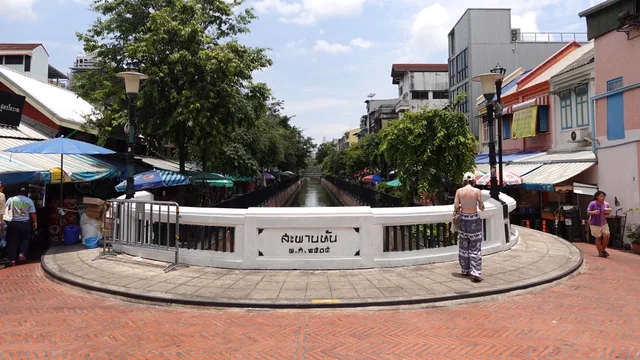
Saphan Han (Bridge)
Phra Nakhon · BangkokWelcome to Saphan Han (Bridge). This footbridge crosses Khlong Ong Ang, a section of the canal that encircles the royal city of Bangkok. It stands at the end of Sampheng Road.
In 1782, Rama the First founds a new dynasty and builds his capital on the eastern bank of the Chao Phraya. Part of the Chinese community lives on the land chosen for the palace. The king resettles them between two canals. This is the birth of Sampheng, which becomes a centre of trade and a port of the first importance.
The canal is dug in 1783. Its name, Ong Ang, means "jars and basins". It recalls the trade in ceramics that took place along its banks. This canal marks a boundary. Inside, behind the city wall, lies the royal city, with its palaces and temples. Outside stretches the Chinese merchant town. The bridge links these two worlds.
The first bridge dates from the reign of Rama the First. The exact year is not known. It is a simple plank laid on piles. It is fixed at one end and simply rests on the other. So it can be swung round towards the city wall, to let masted ships in from the sea pass through. Then it is put back in place for people on foot. Hence its name: Saphan Han means "turning bridge". According to the journalist Kulap, writing in 1899, this bridge uses a technique already known in Ayutthaya, the former capital.
The mechanism does not last. Again according to Kulap, the bridge is damaged early in the reign of Rama the Second. It is rebuilt with two planks, and it no longer turns. Under Rama the Fourth, an iron bridge replaces it. The name, however, remains.
Under Rama the Fourth and Rama the Fifth, the area becomes one of the liveliest in Bangkok. King Chulalongkorn then has the bridge redesigned after two Italian models: the arched shape of the Rialto Bridge in Venice, and the rows of shops on the Ponte Vecchio in Florence. The bridge becomes a covered wooden footbridge, lined with small shops. It is no longer just a way across: it is a place of trade.
In 1962, this bridge of shops is demolished. A reinforced concrete bridge replaces it and keeps its name. This is the bridge you see today, more modest. Yet it is among the oldest bridges in Bangkok, because people have crossed the canal at this spot since the dynasty's first reign.
For more than forty years, a market covers this part of the canal. The stalls hide the water and the bridge. In 2015, the Bangkok Metropolitan Administration has these stalls demolished, despite opposition from traders. The canal and the bridge become visible once more. Today the banks are home to a pedestrian street, murals and food stalls. Around the bridge, the area is still a busy place of trade.
Remember this: on the very same spot, a swinging plank, a fixed bridge, a footbridge lined with shops and a concrete bridge have followed one another, and the name "turning bridge" has lived on for more than two centuries.
Photo : © Eric Monteil
Source: JARUK