
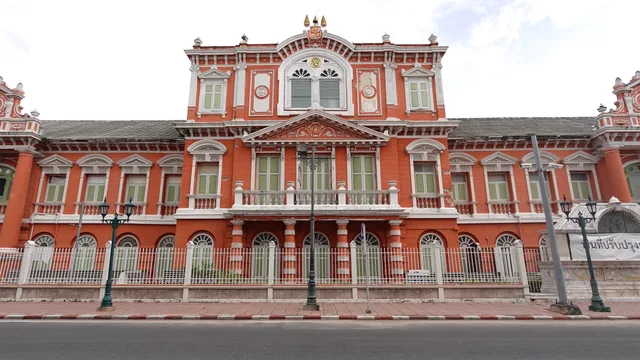
Saranrom Palace
Phra Nakhon · BangkokWelcome to Saranrom Palace, a former royal palace in Bangkok, at the heart of Rattanakosin, the city's historic centre. It stands just a few steps from the Grand Palace. Its story is unusual: this palace never served the purpose for which it was built.
It all begins with King Mongkut, Rama the Fourth. Towards the end of his reign, he considers handing the throne, in his own lifetime, to his eldest son, Prince Chulalongkorn. He wants to remain at his side as an adviser. For this active retirement, he has this palace built from 1866. He gives it the name Saranrom himself. But the king dies in 1868, before the work is finished. The palace is completed in the reign of his son, who has become Rama the Fifth.
The building has two storeys. It is made of rendered brick, that is, brick covered with a layer of mortar. Its architecture is European in inspiration. It reflects Siam's opening to Western models, begun under King Mongkut. The palace also had its own royal garden, in the English style. It held trees, imported orchids, a crocodile pond and a menagerie. For the court, it was a demonstration: Siam had mastered the codes of the Western powers.
The palace soon finds other uses. In 1868, King Chulalongkorn gives it to his brother, Prince Chakrabaddibongse. Other brothers of the king then live here, while their own palaces are being built. From the 1880s, the palace hosts foreign guests of royal rank. The first known guest is Prince Oscar Bernadotte, a prince of Sweden, in 1884. He is followed by a Japanese prince and the heir to the Russian throne, the future Tsar Nicholas the Second.
In 1916, King Vajiravudh, Rama the Sixth, raises the site to the rank of royal palace. Receptions are held here. The palace also houses the royal department of khon, the masked dance theatre of the court. It then brings together two faces of the monarchy: the one that receives foreigners, and the one that nurtures the court arts.
But it is diplomacy that has marked this place most. As early as 1885, the first office devoted to foreign affairs moves in, for two years. In 1926, the ministry returns, and this time for a long while. For more than sixty years, Saranrom Palace is the seat of the kingdom's diplomacy, first Siamese, then Thai. The former retirement residence becomes a place of work, negotiation and representation. The ministry does not leave until 1992.
The most famous moment comes on the eighth of August 1967, in the palace's great hall. The foreign ministers of Thailand, Malaysia, Singapore, Indonesia and the Philippines sign the Bangkok Declaration here. It is the founding act of ASEAN, the Association of Southeast Asian Nations. This hall remains the part of the building most steeped in memory.
Since 2002, the palace has been registered as a historic monument. It has undergone a major renovation, which drew criticism over the quality of the work. The ministry, which still manages it, wants to turn it into a museum of the history of Thai diplomacy, a training venue and a place for receptions.
In front of the palace, on the Sanam Chai Road side, stands a monument to King Mongkut, built between 2004 and 2009. His descendants wanted it for the bicentenary of his birth. It recalls the man who had wanted this palace, yet never lived in it.
The former royal garden, for its part, has taken a different path. It has become Saranrom Park, a public park. A cast-iron gate still stands there, along with the memorial to Queen Sunanda Kumariratana. But the park is not protected like the palace, and the memory of the historic garden is at risk of fading.
Remember this: designed for a king's retirement, Saranrom Palace has been in turn a home for princes, a house for foreign guests, a royal palace, and then the seat of Thai diplomacy. A single place tells the story of Siam's opening to the world and the birth of ASEAN.
Photo : © Eric Monteil
Source: JARUK