
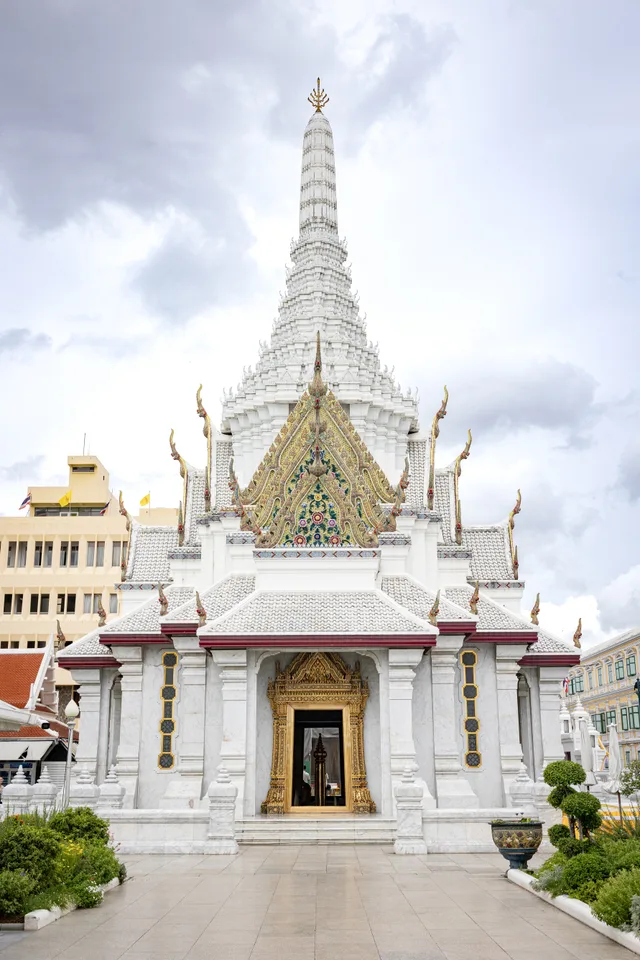
Bangkok City Pillar Shrine
Phra Nakhon · BangkokWelcome to the Bangkok City Pillar Shrine. This place houses the lak mueang, the founding pillar of the Thai capital. It is regarded as the spiritual centre of the city, and even of the whole country.
In Thai, lak mueang means “city pillar” or “city marker”. Custom holds that such a pillar is raised on an auspicious site before a city is founded. So the pillar does not simply commemorate the founding: it is one of the acts of founding itself.
It all begins on Sunday, the twenty-first of April 1782. That morning, King Rama the First has the pillar raised, at a carefully chosen hour. This rite accompanies the founding of the new capital, Rattanakosin. The city’s horoscope depends on that moment: that is, the astrological chart drawn up for the moment of its birth.
The first pillar is carved from chaiyaphruek wood. It ends in a tip shaped like a lotus bud. By the middle of the nineteenth century, this wooden pillar has deteriorated. In 1852, King Mongkut, Rama the Fourth, has a new pillar raised. He also decides to have the city’s horoscope cast anew, for the prosperity of his people. This new astrological chart is placed inside the pillar’s ornate tip, and the pillar stands more than five metres tall.
The king does not have the old pillar destroyed. Today, the two pillars stand together in the same shrine. The one with the lotus-bud tip is the founding pillar. The one with the ornate tip is Mongkut’s pillar, which holds the new horoscope. Side by side, they tell the story of this place: the birth of Bangkok, and then a sovereign’s wish to renew that birth.
Next to the pillar stands a second shrine, the San Thepharak. It houses five guardian deities of the city, linked to this site since the reign of Rama the First. One of them, Phra Suea Mueang, is a statue in gilded bronze. He stands on an octagonal base, wearing a pointed crown, with a lotus flower in his right hand. The pillar marks the city’s origin; the guardians watch over it day by day.
The shrine is registered as a historic site in 1975. For the capital’s two hundredth anniversary, in 1982, King Bhumibol Adulyadej, Rama the Ninth, orders it to be restored and embellished. Today it is managed by the City Pillar Shrine Office, under the care of the War Veterans Organization of Thailand.
Every twenty-first of April, the anniversary of the founding is celebrated here according to Brahmanical tradition, and the State takes part. For the rest of the year, local people and visitors come every day to leave offerings. Some childless couples pray for fertility, other worshippers for prosperity. At Songkran, the Thai New Year, people come here to seek good luck for the year ahead.
Remember this: this shrine guards the spot from which Bangkok is believed to draw its existence. Here, two pillars and five guardians link, every day, the city of today to the act of its founding.
Photo : © Mastertongapollo — Wikimedia Commons, CC BY-SA 4.0
Source: JARUK