
Wat Ratchabophit
Phra Nakhon · BangkokWelcome to Wat Ratchabophit, a royal Buddhist monastery in the heart of Bangkok. King Chulalongkorn, known as Rama V, founds it as the temple of his reign. In doing so, he follows an ancient royal custom. Work begins in 1869, not far from the Grand Palace and Wat Pho. It is completed in 1870.
The temple's name was chosen by the king. 'Ratchabophit' means 'built by the king'. The full name also refers to a great sīmā. The sīmā is the ritual boundary that surrounds the monks' sacred space. Here, it encloses a vast area. So the community's formal acts, such as ordinations, can be held beyond the ordination hall itself. They must then be approved unanimously by the monks.
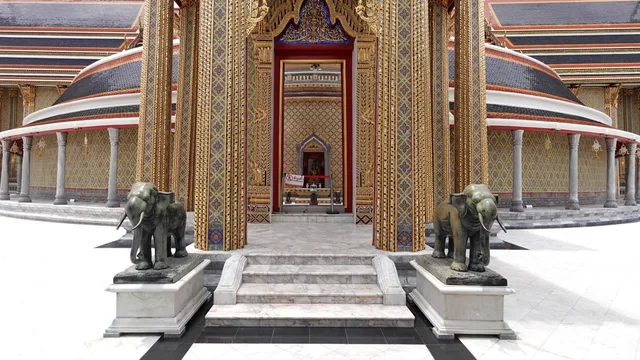
The temple's layout is unusual. At its centre stands a chedi, a bell-shaped reliquary monument. A circular gallery surrounds it. The chedi is covered in a five-colour porcelain mosaic, in the spirit of the ceramics known as benjarong. On either side, two halls face each other. One is the ubosot, the ordination hall. The other is the wihan, the hall for worship and preaching.
Notice the contrast in these two buildings. On the outside, they take the forms of Thai architecture. On the inside, they draw on European architecture, above all the Gothic style. The ubosot has even been compared to an Italian Gothic chapel. The doors and windows continue this dialogue. Those of the ubosot are inlaid with mother-of-pearl and depict the insignia of royal orders. Those of the wihan repeat this motif, but in wood, without inlay. This blend reflects the young king's openness to forms from Europe.
In the mid-1920s, King Prajadhipok, Rama VII, has the temple restored. He treats it as the temple of his own reign. Wat Ratchabophit thus becomes the temple of two reigns. Prajadhipok's ashes rest beneath the base of the principal Buddha image in the ubosot. The place of ordinations is therefore also a king's tomb.
To the west of the compound lies the royal cemetery. It holds around thirty monuments, dedicated mainly to Chulalongkorn's close family. Four large white buildings dominate the whole. Each is dedicated to one of the king's four principal wives. Each also holds the ashes of their descendants. The cemetery is still in use: ashes were placed here as recently as 2012 and 2017.
The link with the dynasty has been renewed in recent years. At the end of October 2017, part of the ashes of King Bhumibol Adulyadej, Rama IX, was placed here. Wat Ratchabophit is one of two monasteries, along with Wat Bowonniwet, to receive his remains. Since the seventh of November 2017, the public has been able to come and pay their respects.
This temple is also home to great monks. It has housed three Supreme Patriarchs, heads of the Thai monastic community. Prince Krom Luang Chinnawonsiriwat leads it from 1921 to 1937. It is he who writes down the history of its construction, published in 1923. Vasana Vāsano is its abbot in the 1970s and 1980s. Finally, Amborn Ambaro has lived at the monastery since 1948. He was ordained as a monk here. He becomes its abbot in 2008, then Supreme Patriarch in 2017. The temple is therefore, in practice, the residence of the current head of the Thai monastic community.
The monastery remains very much alive. Monks of the Dhammayut order live here and carry out their rites. A general restoration lasting about four years was completed in time for the hundred-and-fiftieth anniversary of its founding.
Remember this: Wat Ratchabophit is at once a living monastery, the temple of two reigns, a place of memory for the Chakri dynasty, and the home of the head of the Thai monastic community.
Photo : © Eric Monteil
Source: JARUK