
Wat Ratchanatdaram (Loha Prasat)
Phra Nakhon · BangkokWelcome to Wat Ratchanatdaram Worawihan, the royal monastery of the Loha Prasat, in Bangkok. This Buddhist temple was founded in 1846 by King Nangklao, better known as Rama the Third. He dedicated it to his granddaughter, Princess Somanass Waddhanawathy. The king and the princess laid the foundation stone together.
The princess's life was brief. In 1851, she married the new king, Mongkut, Rama the Fourth, and became queen. She died the following year, barely eighteen years old. The monastery that bears her name has outlived her by more than a century and a half.
The temple's principal monument is the Loha Prasat, literally the "metal castle". In a Thai monastery, the sacred heart is usually a chedi, a massive monument that often houses relics. Here, Rama the Third set aside this usual form. The Loha Prasat serves as both chedi and reliquary. The rites and the life of the community take place in other buildings, the ubosot and the vihara.
Its model comes from texts. Buddhist tradition knows of two earlier Loha Prasats. The first dates back to the time of the Buddha. It is attributed to Visakha, a laywoman counted among his most devoted disciples. The second was built at Anuradhapura, the ancient royal capital of Sri Lanka, with a roof covered in copper plates. It is this metal covering that gave the type of building its name. Neither of these two buildings survives. So Rama the Third set out to give physical form to a description.
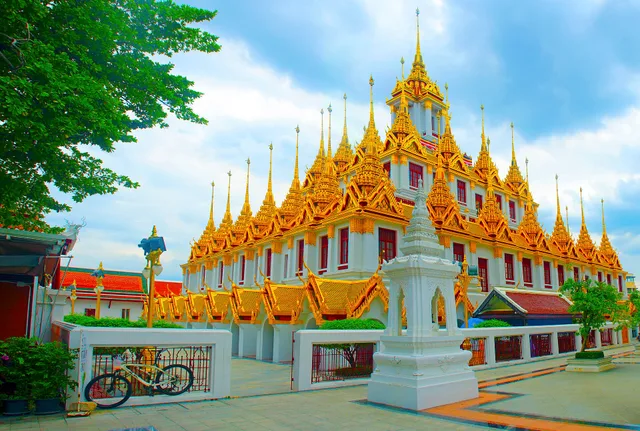
Look at its silhouette. The Loha Prasat has seven levels and thirty-seven spires. This number is no accident. It is linked to the thirty-seven qualities that, according to Buddhist teaching, lead to Enlightenment. Each spire corresponds to one of them. At the centre, a hollow shaft organises the levels. Relics of the Buddha are kept on the seventh and highest floor. As visitors climb, they draw closer to the most sacred point. On the upper floors, small pavilions called mandapa punctuate the terraces. They are crowned with chat, tiered parasols.
Yet Rama the Third never saw his monument completed. The work was still unfinished when he died, in 1851. It remained on hold for decades. Under King Chulalongkorn, Rama the Fifth, an abbot of the monastery obtained permission to restore the building, starting from the top. Its completion is associated with a major restoration in 1963, with the support of Prime Minister Sarit Thanarat. Another chronology places the end of the work a little later, between 1967 and 1976. Either way, the monument was finished more than a hundred years after its foundation.
Since then, its appearance has changed. In 1963, it was red and white. From 1996 to 2007, it was clad in blackened copper. The aim was for it at last to live up to its name of metal castle. Then, from 2012, a new restoration set out to gild the thirty-seven spires. It has been suggested that Rama the Third wanted golden spires, based on a painting of the Loha Prasat at Wat Pho. But this remains a proposal, not a certainty. Each campaign answers the same question in its own way: what was the Loha Prasat meant to look like?
For a long time, the monument was hidden. A cinema, the Sala Chaloem Thai, opened in 1949, completely blocked the view from Ratchadamnoen Avenue. In 1989, it was demolished, precisely because it concealed the temple. The land thus freed now holds the Mahajetsadabadin royal pavilion, which receives state guests, and a memorial dedicated to Rama the Third. The founder is thus honoured at the foot of the monument he had wished for.
To remember: the Loha Prasat is a reliquary born of an ancient story, commissioned by a king for his granddaughter, and completed long after him. Abbots, governments and architects have in turn finished and reinterpreted it, and it is this long history that makes it so distinctive today.
Photo : © Rangan Datta Wiki — Wikimedia Commons, CC BY-SA 4.0
Source: JARUK