
Ancient City Wall
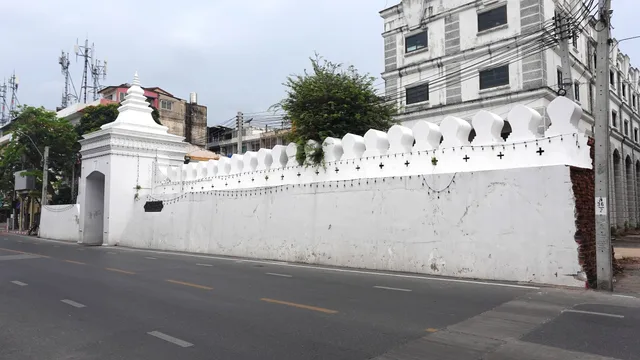
Phra Nakhon · BangkokWelcome to the Ancient City Wall, on Thanon Phra Sumen. This stretch of wall and this sealed gate are, together with one other section, all that remains of the city wall built when Bangkok was founded.
Let us go back to 1782. King Rama the First has just come to the throne. He moves the capital of the kingdom. It leaves Thonburi, where King Taksin reigned, for the east bank of the Chao Phraya River. The new city takes the name Rattanakosin. The river and canals surround it almost entirely. Today, people speak of Rattanakosin Island.
From its very first years, the capital gives itself a city wall. Walls and forts go up in 1782 and 1783. At the time, founding a capital also meant enclosing it. The wall marks the boundary of the royal city and organises its entrances.
To build it, Rama the First reuses materials already in place. He takes those from Taksin's old walls. He also takes those from the ruins of the fort of King Narai, who ruled Ayutthaya in the seventeenth century. Others come from the fortifications of Ayutthaya itself, destroyed a few years earlier. So this wall brings together fragments of the capitals that came before Bangkok.
The city wall forms a genuine defensive system. The masonry wall is pierced by sixty-three gates. Fourteen forts stand along it, armed with cannon. To the north, a canal serves as a moat: Khlong Bang Lamphu. This fragment is only a small part of that whole.
You are on the northern side of the old city. The word 'thanon' means 'street'. This street follows the old line of the wall. In this way, it keeps the line of the vanished wall in the plan of the city. Facing the wall stands Wat Bowon Niwet, a Buddhist monastery. Just north of the monastery stood Fort Yukhonthon, which has since disappeared.
This section has one special feature: its gate. Of the sixty-three openings in the city wall, it is the only one that survives. It was a so-called 'outer' gate, linking the walled city with its surroundings. Today its passage is blocked with bricks and cement. It keeps the shape of a passage that no longer opens.
Why is so little left? In the second half of the nineteenth century, Bangkok spills beyond its limits. Most of the walls and forts are removed or replaced. Roads and buildings take their place. During the reign of Rama the Sixth, all the forts are pulled down, except Mahakan and Phra Sumen. In all, the wall and twelve of the fourteen forts were demolished.
Today, two short sections of the wall survive: this one, and the one beside Fort Mahakan. Both belong to the same city wall. But their recent history is very different. The Mahakan wall was listed as a historic monument, restored, then excavated. It was then cleared of the community that lived behind it, after a long dispute. The park that replaced the community has remained little visited.
Nothing like that has happened here. Thanon Phra Sumen has become a lively street, lined with cafés, restaurants, galleries and bookshops. Passers-by walk along the wall without going through any entrance or following any route. The best view is from the other side of the street. From there, you see the masonry wall and the brick-blocked gate, between the shopfronts and the traffic.
Take a moment to imagine what has gone. The continuous wall linking the forts. Fort Yukhonthon close by. The Bang Lamphu canal to the north. And the sixty-three gateways through which people entered the capital of Rama the First.
Remember this: this stretch of wall is one of only two surviving fragments of Bangkok's founding city wall, and its sealed gate is the last surviving gateway of the capital of 1782.
Photo : © Eric Monteil
Source: JARUK