
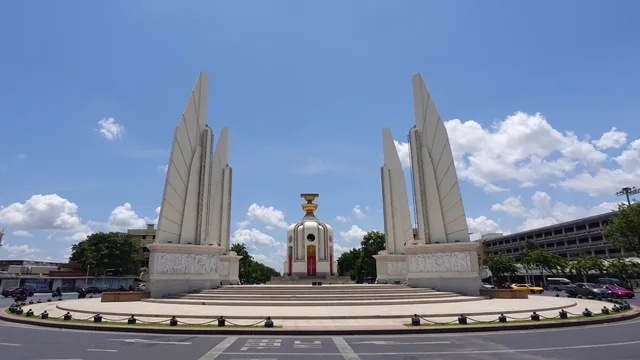
Democracy Monument
Phra Nakhon · BangkokWelcome to the Democracy Monument, in the middle of a roundabout on Ratchadamnoen Klang Avenue, in the centre of Bangkok. This monument commemorates a founding moment: the change of regime on the twenty-fourth of June 1932. On that day, the Khana Ratsadon, the People's Party, brings absolute monarchy in Siam to an end. The Constitution adopted that same year becomes the reference point of the new political order.
Yet the monument was not born in 1932, but seven years later. In 1939, the government of Prime Minister Phibun, a military man, commissions it. The foundation stone is laid on the twenty-fourth of June 1939, the anniversary of the revolution. The inauguration takes place a year later, to the day. This monument pays tribute to the revolution. But it also asserts the power of the man who had it built.
The chosen site matters too. Ratchadamnoen Avenue was commissioned in 1899 by King Chulalongkorn, Rama the Fifth. So the new regime places its emblem on a route laid out by the monarchy. Phibun wanted to make this avenue the Champs-Élysées of Bangkok, and the monument its Arc de Triomphe.
At the centre stands a round turret. On its summit rests the main element: a representation of the 1932 Constitution. It takes the form of a samut thai, the traditional Thai book made from a single folded sheet. This book sits on a phan waen fa, a golden offering tray, on a pedestal and with two tiers. The founding text of the regime thus takes on the appearance of a familiar object from Thai culture. The sculpture is three metres high and weighs some four tonnes.
Around the turret, a raised terrace holds four flat wings, standing at the four points of the compass. The enclosure is made of seventy-five old cannons, buried muzzle down and linked by a chain.
Here, the measurements owe nothing to chance. The wings rise to twenty-four metres: that is the twenty-fourth of June. The three metres of the Constitution stand for June, the third month of the old Thai year. The seventy-five cannons recall the year 1932 in the Buddhist calendar then in use. And the chain symbolises the unity of those behind the change of regime. For anyone who knows how to read it, the monument is a calendar of the revolution.
At the foot of the wings, stucco reliefs tell the story of the People's Party up to the twenty-fourth of June 1932. They are the work of the Florentine sculptor Corrado Feroci, known in Thailand as Silpa Bhirasri. One of the panels is entitled "Soldiers fighting for democracy". The army plays the leading role. Civilians appear only as grateful beneficiaries. These images reflect the viewpoint of the 1939 regime, dominated by the military.
And yet the monument has changed its meaning. From the 1960s onwards, the democratic movement takes it over. Processions set off from Thammasat University, cross the open ground of Sanam Luang, follow the avenue and end up here. By gathering at the foot of the sculpted Constitution, the protesters appeal to the very text the monument celebrates. In 2020, major demonstrations follow one another here. One evening in July, participants light up the Constitution with the glow of their phones.
Today, the monument is not registered as a historic site. But any work on its structure must be authorised by the Fine Arts Department. In 2026, the Bangkok Metropolitan Administration puts up a metal fence around it. It denies any intention of demolishing it and announces maintenance work. Even so, these announcements cause concern among some local residents.
Remember this: designed to legitimise an authoritarian power, the Democracy Monument has become the rallying point for those who call for more democracy. It is this reversal that makes it so remarkable.
Photo : © Eric Monteil
Source: JARUK