
The Giant Swing (Sao Chingcha)
Phra Nakhon · BangkokWelcome to The Giant Swing (Sao Chingcha), the great red gateway of Bangkok. It stands on Dinso Road, just in front of the royal monastery of Wat Suthat, in the historic heart of the capital, on Rattanakosin Island.
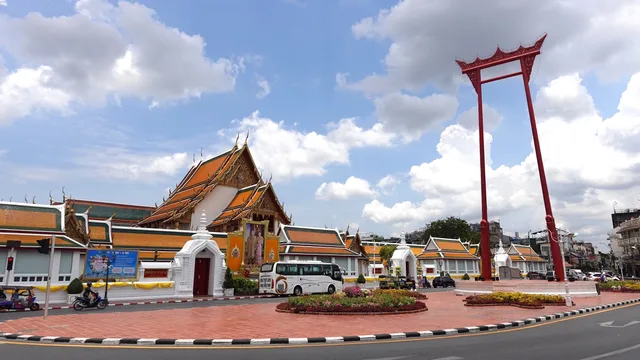
Look at these two wooden posts, lacquered in vermilion. They rise to more than twenty-one metres and carry a crossbeam at the top. They rest on a tall circular base, shaped like a lotus base. On each side, two shorter posts support the main uprights.
The Thai name describes what you see. Sao means "pillar", chingcha means "swing". Sao Chingcha is the pillar of the swing. For this gateway is not mere decoration. It is ritual equipment.
It was built in the reign of King Rama the First, in the early years of the new capital, in 1784 according to most accounts. It served a royal ceremony, the Triyampawai, commonly known as the swinging ceremony. It was one of the twelve royal ceremonies of the year. Its officiants were the court Brahmins, priests of the Hindu faith. The rite honoured Shiva, one of the great gods of Hinduism.
During the ceremony, officiants swung to delight the god. The rite brought together three swing boards and twelve performers, called naliwan. The two posts represent the mountains on either side of the ocean, in the myth that the ceremony re-enacts. It was an impressive spectacle, but a dangerous one. Several participants died in falls.
This place tells a story of coexistence. Wat Suthat, just behind the swing, is a great royal Buddhist monastery. Close by stands the Devasathan, the royal Brahmin temple where the court Brahmins live. The king, protector of Buddhism, also relied on these Hindu priests for some of his rites. Here, the two traditions stand side by side, neither one erasing the other.
The swinging stopped in 1935, according to most accounts. Explanations vary: the fatal falls, the decline of the court Brahmins' role after the revolution of 1932, or the cost of the ceremony. These reasons are not mutually exclusive. Since then, no one has swung at Sao Chingcha.
The gateway itself remains. In 1949, it was registered as a national historic monument. But the wood suffers in Bangkok's climate. In the early two-thousands, water seeped in through the joints and rotted the posts. In 2007, a new structure was raised using six great teak trunks from Phrae, in the north of the country. A three-day consecration ceremony marked the end of the work. For the gateway is still a sacred place: its repair must follow Brahmin rules.
What you see is therefore entirely new in its material. The old timbers are kept at the National Museum in Bangkok. The monument's continuity lies in its form, its place and its consecration, handed down from one rebuilding to the next.
And the rite has not disappeared. The court Brahmins still celebrate the Triyampawai at the nearby Devasathan. On the third day, once the day of the swinging, swing boards are placed in holes. The object is there, but the movement is gone.
Around the gateway there was also once a market, known for its brass jewellery imitating gold, the "gold of Sao Chingcha". It was demolished in 1954. Bangkok City Hall now occupies the site.
Remember this: this vermilion gateway is far more than an emblem of Bangkok. It is the equipment of a royal rite dedicated to Shiva, rebuilt in teak and consecrated. It reminds us that the Thai monarchy long relied on both Buddhism and a Hindu cult.
Photo : © Eric Monteil
Source: JARUK