
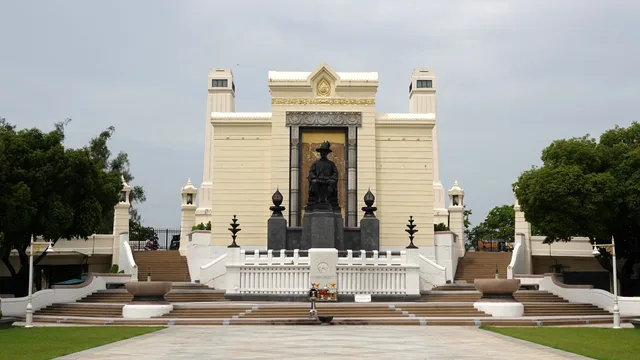
King Rama I Monument
Phra Nakhon · BangkokWelcome to the King Rama I Monument, at the foot of the Memorial Bridge, in Bangkok. This memorial honours King Phra Phutthayotfa Chulalok, known as Rama the First. He was the first sovereign of the Chakri dynasty. In 1782, he established the kingdom's capital at Bangkok. To honour this king is to honour both a dynasty and a city.
King Prajadhipok, known as Rama the Seventh, wanted this monument for the hundred and fiftieth anniversary of the capital. He did not want just a statue. At the same time, he had a bridge built across the Chao Phraya River. So the statue and the bridge form a single memorial. In fact, they share the same official name in Thai: Pathom Borommarachanuson.
The king is seated on a throne, dressed in ceremonial royal attire. Both his hands rest on a sword laid across his knees. This bronze statue stands about four point six metres high. It faces towards Tri Phet Road and the old city, with its back to the bridge.
Prince Naris designed the statue and oversaw its making. The modelling and casting were entrusted to Corrado Feroci, a sculptor who had entered the service of the Siamese government in 1924. Feroci, later known by the Thai name Silpa Bhirasri, would become a leading figure in the country's art education. His portrait is realistic, in the Western manner. This was something new: until then, royal and sacred figures had been idealised. Here, the face and body give the king a human presence.
Behind the statue rises a marble wall. It is cut with a deep niche shaped like a doorway, against which the figure of the king stands out. Two carved columns frame it. At the top, the pediment bears stucco garlands, crowned by an unalom. This decoration blends Thai and Khmer forms. It is in keeping with the bridge's Art Deco pylons.
In front of the monument lies a wide esplanade. Prince Naris intended it to host a grand ceremony of homage every year. Even today, offerings are laid at the foot of the statue, among floral arrangements shaped like lotus flowers. A fountain stands on each side.
The monument and the bridge were inaugurated on the sixth of April 1932 by King Prajadhipok. It was Chakri Day, dedicated to the memory of the dynasty. The king operated an electric switch with a silver hammer, then unveiled the statue. He sprinkled it with lustral water and anointed it. Modern technology and royal ritual came together on the same morning.
A few weeks later, on the twenty-fourth of June 1932, a revolution brought absolute monarchy in Siam to an end. For the art historian Chatri Prakitnonthakan, this memorial is the last monument of the absolute monarchy.
Remember this: this monument is not just a statue. Conceived together with the bridge, it honours both the first Chakri king and the capital he founded, and it has become a witness to the end of a regime.
Photo : © Eric Monteil
Source: JARUK