
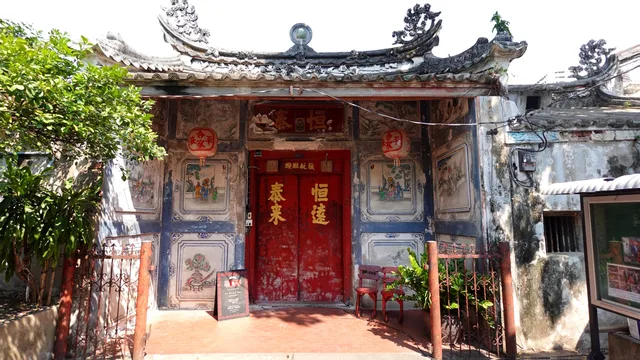
So Heng Tai House
Samphanthawong · BangkokWelcome to So Heng Tai House, a Chinese courtyard house in the Talat Noi district of Bangkok, on the east bank of the Chao Phraya. It is one of the last traditional Chinese mansions in the city. And it has a rare distinction: the descendants of its founders still live here.
This house was born of trade. Its story begins with a Hokkien merchant named Chat. The Hokkien are Chinese people from Fujian province, on the south-east coast of China. By the reign of Rama the Second at the latest, Chat runs the Po Seng pier in Talat Noi. He then receives a plot of royal land on the riverbank. There he has a group of Chinese buildings put up. At the time, the neighbouring pier is an important hub for trade with China. Rice passes through it, and so do swiftlet nests.
It is this second product that makes Chat's fortune. He holds the tax monopoly on swiftlet nests: in Thai, he is called a nai akon, a tax farmer. The house serves as both the family home and the office of the family business, which exports the nests to China. Under the reign of Rama the Third, the merchant is ennobled. He receives the title Phra Aphaiwanit.
When was the house built? The date is hard to establish. According to one account, around 1797, at the start of the Rattanakosin period. According to another, rather around the middle of the nineteenth century. Nothing allows us to decide. Even so, in the neighbourhood it is known as "the two-hundred-year-old house". It is also called "the house with the red door".
Now take a look at its architecture. The house follows the plan of the siheyuan, the traditional Chinese house whose buildings enclose a square courtyard. Four wooden wings frame a central courtyard. According to family tradition, its style is Hokkien, like its founders. The buildings are made of golden teak, topped with traditional Chinese roofs. Two Chinese lanterns, the teng lung, frame the door.
In the centre of the courtyard, a surprise awaits you: a diving pool, four metres deep. It was installed in 2004, when the house became a diving school. This choice is linked to Poosak Posayachinda, a diving instructor and an eighth-generation descendant. The upkeep of the mansion is very expensive, and the school brings income to the family. Several thousand students have trained here. The old plan, for its part, remains in place: the pool occupies the space that was already the centre of the house.
The house has never left the family. Seven owners have followed one another. Under the reign of Rama the Sixth, the descendants receive the family name Posayachinda. This is not a museum: it is a house where people live. From 2014, it opens to the public more often, and a café welcomes visitors. For Poosak Posayachinda, the house led to the rediscovery of Talat Noi. Visitors came for the house, and then the district saw the arrival of street art and cafés.
Yet the house remains fragile. On the thirtieth of June 2022, at around two in the morning, part of it collapses, in the area of the kitchen and the bathrooms. No one is hurt. This accident is a reminder of one reality: the place is recognised by all, but a single family looks after it.
Remember this: So Heng Tai House is the home of a clan of Hokkien merchants made wealthy by swiftlet nests, and the same family line has lived here ever since it was built.
Photo : © Eric Monteil
Source: JARUK