
Alex Face Mural Art
Phra Nakhon · BangkokWelcome to the Alex Face Mural Art. You are on the bank of Khlong Ong Ang, in Phra Nakhon district, the old heart of Bangkok. The Thai word khlong means a canal. Here, this canal runs between the Wang Burapha Phirom area and the area of Phahurat and Chinatown.
You won't find this painting in a museum or a gallery. It belongs to the street. This is street art, an art that uses the walls of public space as its surface. It is there for anyone who passes by. It also shares the risks of the street: a wall can be repainted, altered or demolished.
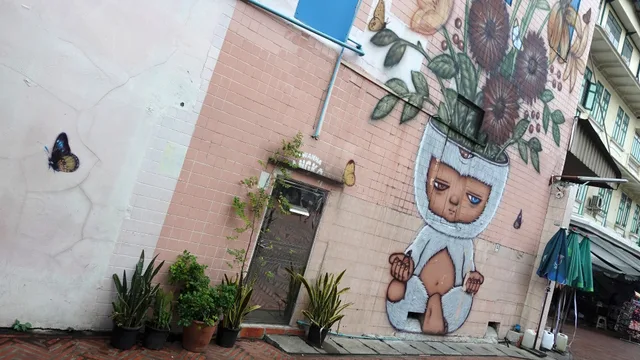
On this wall, you can see Mardi, a child you can recognise by his three eyes. Alex Face has been painting this character since two thousand and nine. In his other works, Mardi usually looks sleepy, or else suspicious. Here, the artist has chosen to show him meditating.
Alex Face is the pseudonym of Patcharapol Tangruen. He was born in nineteen eighty-one. He comes from Chachoengsao province, and he lives and works in Bangkok. His name comes from the tag, the spray-painted signature that graffiti writers repeat from wall to wall. Sometimes he tagged his name, sometimes his face, sometimes random designs. His first graffiti signed Alex Face dates from two thousand and two. He painted it on an old car.
He trained in fine and applied arts at King Mongkut's Institute of Technology. At first, he painted in Bangkok's abandoned buildings. Then his work began to travel. His murals can be found in London, in Tokyo and in Berlin. He is one of the artists who made Thai street art known abroad. One of his works belongs to the permanent collection of MOCA Bangkok, the capital's museum of contemporary art.
Mardi was born in two thousand and nine, after the birth of the artist's daughter. The newborn's face looked grumpy to him. It was as if the child were already worried about her future. The artist carried this impression over into his character. Since that birth, he explains, he has worried about the future of his city, his country and the planet.
Mardi is a child dressed in a rabbit costume, or a fluffy animal outfit. For the artist, the rabbit stands for the victim in today's world. Children, too, are presented as victims of the media, marketing, education and society. The third eye, always on the alert, watches what the other two avoid. It gives the character an unexpected watchfulness beneath the softness of the costume. Beyond the artist's daughter, Mardi is presented as the voice of ordinary people in Bangkok and the neighbouring provinces.
Look, too, at the way it is painted. Alex Face works with spray paint. But he uses it gently enough for his street paintings to look as though they were made with a giant brush. In this way, they recall gallery painting. For him, the street is not a place for a quick sketch. It is a surface for painting in its own right.
This mural was in place around the end of two thousand and twenty. It was still visible in February two thousand and twenty-two. But street art is ephemeral by nature, and Alex Face knows it. In Phuket, a painting of Mardi was contested. A meeting voted for its removal, and the artist erased it himself. He said at the time that street artists accept that their works will be painted over sooner or later.
Remember this: on this wall in old Bangkok, Mardi, the three-eyed child, carries a father's worry for the future of his child, his city and the planet, as well as the voice of ordinary people. It is a work given to the street, and it exists for as long as the wall, the neighbourhood and passers-by allow it to exist.
Photo : © Eric Monteil
Source: JARUK