
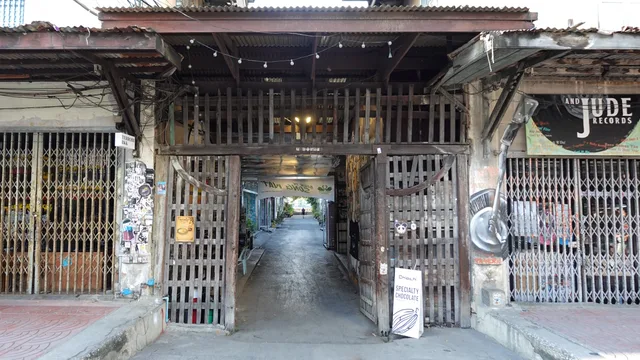
Songwat Lane
Samphanthawong · BangkokWelcome to Songwat Lane, a historic street in the Samphanthawong district of Bangkok. It runs alongside the Chao Phraya River, on the edge of the capital's Chinatown. For decades, it was one of the gateways to the city's river trade.
The street runs for about one kilometre. It starts at Ratchawong Road, near Ratchawong Pier, and heads east to the Khao Lam roundabout, where it meets Charoen Krung Road. On the river side, small streets and alleys lead down to the quays. One of them, Song Soem Road, is only about twenty metres long. It is said to be the shortest road in Thailand.
The street's name, Song Wat, translates as "drawn by the king". It refers to King Chulalongkorn, known as Rama the Fifth. Tradition has it that he traced the route of the street himself, in pencil, by his own hand, on a map.
The street was born after a great fire in Sampheng, the old Chinese merchant quarter of Bangkok. The Siamese government then wanted to relieve this very crowded quarter and support a booming trade. A first section was completed in 1892. The second, which joins Charoen Krung Road, was completed in 1907.
The alleys lead to the port. Here, steamers docked, linking the capital with Chon Buri province and with Ban Don, in Surat Thani province. Seafood, vegetables, plants and herbs arrived by boat. The district became a key centre for import and export.
On both sides of the street stand rows of shophouses, those narrow, terraced shop-and-home buildings. They are mostly home to wholesalers. Songwat Lane was known for spices, rice and warehousing. Many buildings served at once as shops, offices and warehouses. Old spice warehouses still stand by the river. The façades blend Chinese traditions with European forms. Some call them colonial, others neoclassical.
The street is closely linked to the Chinese and to Thais of Chinese descent. Several great families of chao sua, the trading tycoons, began here. But the neighbourhood was never uniform. Thai, Chinese and Muslim cultures mix here, and Indian merchants kept shops here too. The Luang Kocha Itsahak Mosque bears witness to this. Built under Rama the Fifth, it has a European, neoclassical style, and stands out for its yellow colour. It is said to be the only mosque within the Chinese community. At the end of the street, the Indian Building, a former textile shop run by Indian merchants, recalls this multicultural past. The street's primary school houses, in one of its old buildings, a local museum devoted to the history of Bangkok's Chinatown.
Then river freight ceased to be the main way of trading. Many shophouses were abandoned. A new generation of local families has restored many of them. In 2016, large works of street art were painted at the eastern end of the street, during the Bukruk Urban Art Festival. Cafés, galleries, hostels, shops and restaurants moved in. In 2022, the Made in Song Wat collective was founded, bringing together young entrepreneurs, long-established traders and residents. In 2023, Time Out magazine included the street in its ranking of the "coolest" neighbourhoods in the world.
Yet the protection of these buildings remains fragile, and their conversion raises the question of authenticity.
Remember this: Songwat Lane is a trading street born of a royal decision, where Chinese, Thais, Muslims and Indian merchants lived side by side. Today, its residents are giving it a second life, between merchant memory and new life.
Photo : © Eric Monteil
Source: JARUK