
Talad Noi Museum
Samphanthawong · BangkokWelcome to the Talad Noi Museum. You are in a community museum of local history, on the banks of the Chao Phraya River, in Talat Noi, the old Sino-Thai quarter of Bangkok. It opened in 2024 and is run by the Treasury Department of the Ministry of Finance. It tells the story of a community of Chinese craftspeople who have lived here since the capital was founded.
Talat Noi means 'small market'. The quarter took shape on the east bank of the river when King Rama the First moved the kingdom's capital here, in 1782. Chinese families then settled a little to the south of Sampheng, the great Chinese market of the young city. Talat Noi grew up beside this larger neighbour and received some of its goods. In Teochew, one of the Chinese dialects of the quarter, it was called Tak-lak-kia: the small market that received goods from Sampheng.
But Talat Noi is not only a place of trade. Other old names recall the work of its people: the 'wok workshop', or the 'house of the Chinese metal casters'. They point to a skill in metalwork. The museum's site belongs to this history. It once housed a large lathe workshop. Parts were made here for boats, machines and rice mills, the factories where rice is processed. After the workshop closed, this state-owned land was left derelict.
The project grew out of an anniversary. The economist and educator Puey Ungphakorn, born in 1916, spent his childhood in Talat Noi. The centenary of his birth, in 2016, offered a chance to honour him in the quarter where he grew up. The architects say they drew inspiration from one of his texts on the 'quality of life'. Launched in 2015, the project ran into a dispute in 2019 over how the land would be shared. It was settled by an agreement: the former tenant kept part of the plot, and the museum received another part. The museum was inaugurated on the sixth of March 2024.
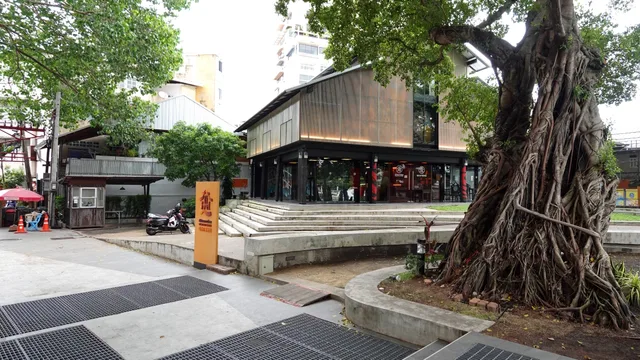
Look at the building. It takes the shape of the old workshop and reuses its timber. Yet it is not simply a restored workshop: it is a new design, mindful of the history of the site. Through its outline and its materials, it is already the museum's first exhibit. It evokes craftsmanship even before you reach the galleries.
The site was designed by the Arsom Silp Institute of the Arts, together with the Treasury Department and the Talat Noi community. The residents are regarded as its co-producers. Around the museum, a garden shaded by tall trees opens onto the river. It is the first and only riverside garden in this old quarter.
On the ground floor you will find the reception, a shop and a space for temporary exhibitions. This level is also a learning centre on Thai money through the ages. This is where you register before going upstairs. Upstairs, the main exhibition presents Talat Noi as a community of Chinese craftspeople from the early Rattanakosin era, a place of many cultures. The route has six sections, and several of them appeal to different senses. One area introduces the five dialect groups of the quarter: Hokkien, Teochew, Hakka, Cantonese and Hainanese. It shows how their cuisines have blended. The final section is devoted to the ancestors, the founding families who arrived in the late eighteenth century.
Today, Talat Noi is changing fast. Cafés, galleries and visitors are flocking in, while the ageing resident population is shrinking. The museum welcomes those discovering the quarter, while having been designed with those who still live here.
Remember this: the Talad Noi Museum is at once a tribute, a neighbourhood museum and a public garden. It turns a former workplace into a place of memory, designed with the residents rather than for them.
Photo : © Eric Monteil
Source: JARUK