
MOCA Bangkok
Chatuchak · BangkokWelcome to MOCA Bangkok, the Museum of Contemporary Art. This private museum is devoted to modern and contemporary Thai art. It opens its doors to the public on 18 April 2012, in the north of the capital.
Before it was a museum, this place was a collection. And that collection belongs to one man, the businessman Boonchai Bencharongkul. He made his fortune in telecommunications. In the 1970s, he studies both painting and management, in the United States. In 1980, he buys his first painting, directly from the artist Panya Vijitthanasarn. It is an abstract painting: a red triangle, presented as a Buddhist allegory. This canvas never leaves the collection. More than thirty years later, it is among the works on show in the newly opened museum.
Boonchai Bencharongkul is described as a collector who buys and never sells. His collection has therefore grown acquisition by acquisition. It bears the trace of his successive choices. It numbers more than eight hundred works, and more than four hundred are on display at the opening. The founder intended this museum as an introduction to contemporary Thai art. He says he follows the example of Lorenzo de' Medici as a patron.
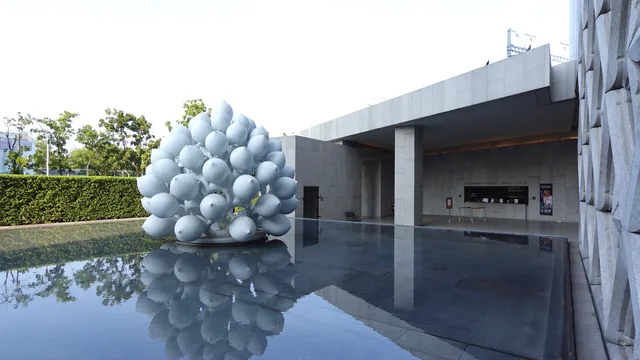
The building was built for the collection. From the outside, it looks like an enormous block of granite set on the ground. Its façade gives it its character. The granite is hand-carved with a jasmine motif, presented as a mark of Thai identity. This motif is not merely decoration. Its openwork lets in natural light, and the atmosphere changes with the seasons.
In front of the entrance stands a sculpture in the shape of a lotus bud. It is called Piti Suk, and the museum has made it its symbol. It is the first work you encounter, even before you step through the door.
The visit begins in the ground-floor hall, in front of a statue of Silpa Bhirasri. He is regarded as the father of contemporary Thai art. This choice is no accident. The museum was created above all to honour two figures: King Bhumibol Adulyadej and Silpa Bhirasri. So before you see the works, you pay your respects to the master whom modern Thai art claims as its own.
The route then climbs floor by floor, up to the fifth level. The ground floor brings together two rooms. The first presents the sculptures of Paitun Muangsomboon, honoured as National Artist for sculpture. The second shows the paintings and sculptures of Professor Chalood Nimsamer.
The second floor is devoted to contemporary art. Chalermchai Kositpipat holds an important place here. Named National Artist in 2011, he is known for his works on Buddhist themes. The third floor explores the imaginary and the fantastic in contemporary Thai art.
The fourth floor belongs almost entirely to a single artist: Thawan Duchanee, also a National Artist. He dominates the whole collection. From the opening, more than one hundred of his works are on display in the museum. The highlight of this floor is a set of three very large paintings, devoted to the three realms: heaven, earth and hell.
On the fifth and final level, Thai works are shown alongside works by artists from many countries. The museum also holds traditional masks, shadow puppets and string puppets, from Thailand and other countries in Asia.
In 2022, the museum celebrates its tenth anniversary. It is then run by Kanachai Bencharongkul, the founder's son. The permanent collection remains the heart of the place. But temporary exhibitions follow one another at a regular pace, and the museum also hosts outside galleries. In this way, artists from today's scene come into the building, alongside the great masters.
Remember this: MOCA Bangkok tells the story of Thai art through the eyes of a collector, under the sign of Silpa Bhirasri and the King, in a building that displays Thai identity right down to its stone.
Photo : © Eric Monteil
Source: JARUK