
BACC
Pathum Wan · BangkokWelcome to the Bangkok Art & Culture Centre (BACC), the City of Bangkok’s centre for contemporary art. It stands at the Pathumwan intersection, in the Siam shopping district. You can reach it from National Stadium station on the BTS, the capital’s elevated railway. Its Thai name, Hô Sinlapa Watthanatham haeng Krung Thep Maha Nakhon, means ‘house of the arts and culture of Bangkok’.
This is not a museum in the traditional sense. The centre has no permanent collection. It presents temporary exhibitions of modern and contemporary art. It also hosts concerts, theatre, film and design. Its purpose lies less in the works it owns than in the works it brings to the public, the artists it welcomes and the audiences it brings together.
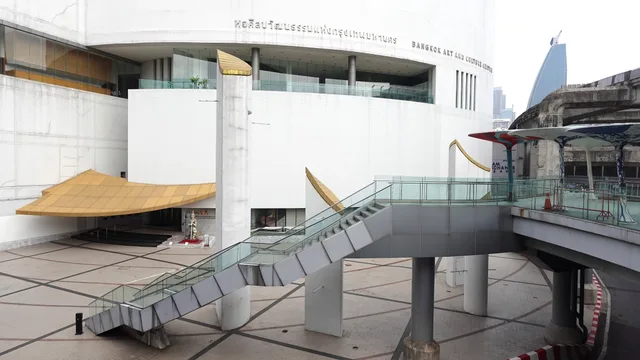
The building is designed as a cylinder of stone and concrete, in a contemporary, modernist style. At its heart is a central atrium: a large interior space open across several levels, ringed by balconies that run all the way round. This atrium also serves as a stage, and performances take place here. On a plot of around four thousand eight hundred square metres, the building rises upwards. It is the work of Robert George Boughey, an American architect based in Bangkok since 1973.
This place was born of a long struggle. In 1996, the Governor of Bangkok, Bhichit Rattakul, decides to build a city-owned centre for contemporary art here. The design by Robert Boughey’s firm is chosen. But in 2001, a new governor, Samak Sundaravej, halts everything. He wants a more commercial scheme. The idea of turning the site into a car park then begins to circulate.
The artists respond. Together with students and members of the public, they defend the abandoned project. A grassroots network forms and organises a gathering called Art Vote, on the site, which has meanwhile become a public park. On the nineteenth of August 2005, Governor Apirak Kosayodhin officially announces the construction of the centre, in front of some five hundred people from the art world. And it is indeed the building the artists defended that is chosen. A Bangkok Declaration on Art and Culture is also signed between the city and an alliance of arts and cultural organisations.
After many delays, the centre opens its doors on the twenty-ninth of July 2008. Commerce does find a place here in the end, but in the service of art. Cafés, bookshops, galleries and craft shops make up the area known as artHUB, whose rents help to fund the centre. A specialist library, the BACC Art Library, completes the whole.
The centre does not plan its programme alone. Independent collectives, educational institutions, public bodies, associations and companies present their own projects here. It is also a major venue of the Bangkok Art Biennale, an international contemporary art event held every two years at several venues across the city.
The centre is run by a non-profit foundation, but the city remains its main funder. This balance is fragile. Towards the end of its first decade, the city announces that it will not pay its annual grant. In May 2018, it announces that it wants to take over the running of the venue directly. The artists protest, and the change is postponed. In 2025, the city asks the centre to remove or censor content from an exhibition deemed offensive to China. Freedom of programming then becomes a source of conflict.
Remember this: the BACC is far more than a building. It is a house of the arts that artists, students and local people won back from other uses. At the heart of a district given over to commerce, it remains a place of creation, and a point of contention between those who fund it and those who bring it to life.
Photo : © Eric Monteil
Source: JARUK