
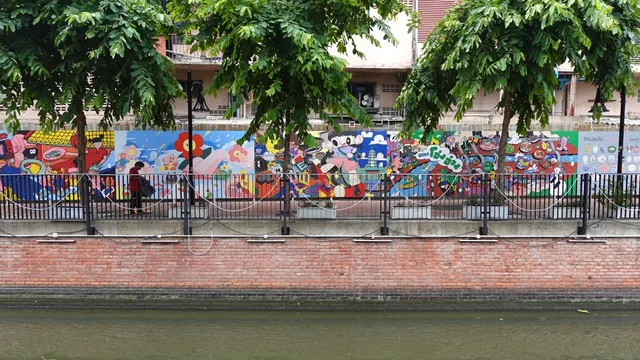
Khlong Ong Ang Street Art
Samphanthawong · BangkokWelcome to the banks of Khlong Ong Ang, in the heart of Bangkok's old town. The walls along both its banks are covered in murals. This collection of wall paintings, created since 2020, is called Khlong Ong Ang Street Art.
The canal itself is much older. It was dug in 1783, during the reign of Rama the First: it is the city's second moat. Khlong means canal in Thai. Ong Ang is the name of its last stretch, which runs down to the Chao Phraya River. The name preserves the memory of a trade. Ong means jar. Ang means basin. Mon and Chinese merchants once sold jars, basins and terracotta pottery here.
Today, the canal divides two Bangkok districts, Phra Nakhon and Samphanthawong. Several neighbourhoods meet along its banks. Phahurat is home to the Indian community. Sampheng is home to the Chinese community. The third is Sam Yot. This mix of Thai, Chinese and Indian communities provides much of the murals' subject matter.
For decades, however, the canal almost vanished. The Saphan Lek market had spread out over the water. Its stalls, known for toys, video games and cameras, covered it completely. A fruit seller with a stall on the bank remembers it well. Untreated wastewater was poured into the canal, and the traders' tarpaulins hid the opposite bank.
In the late 2010s, the Bangkok Metropolitan Administration cleared the canal. The water was cleaned up and the historic bridges were restored. Lit, brick-paved walkways now run along both banks. The walls, long hidden behind the stalls, came back into view.
In October 2020, Thai street artists came to paint them. Their aim was specific: to announce the opening of the new pedestrian street on the evening of Loy Krathong. The canal's street art was therefore born of this redevelopment.
The murals tell of Bangkok's old life by the water and the history of the communities along its banks. Each artist keeps their own style. But together they read like an illustrated chronicle of the neighbourhood, to be discovered on foot from one bridge to the next. Look at the ground too. At five spots around the canal, manhole covers bear designs representing the identity of the communities. At the Saphan Lek bridge, one of them displays the word sawasdee, "hello", to greet visitors.
In mid-March 2021, the canal's redevelopment received the Asian Townscape Award 2020. The prize is awarded by the UN-Habitat Regional Office for Asia and the Pacific. The jury praised the improvement to the landscape, but also the place given to art and culture. The canal became a model, followed on other canals in the capital.
Every weekend, the place changes character. From Friday to Sunday, from late afternoon into the evening, the banks become a pedestrian street and a night market. You will find music, food and craft stalls, and kayaks for paddling up the canal between the murals. The canal also hosts major festivals, such as Loy Krathong and Songkran, the Thai New Year.
The collection is not fixed. In 2024, an art festival added six murals in the Sam Yot neighbourhood. That same year, during Loy Krathong, artists depicted the history of the canal on a wall a hundred and twenty metres long.
This success has drawn some reservations. Some felt that cosplay, graffiti and kayaking had nothing to do with the life of the neighbourhood. The murals tell the story of long-established communities, but they attract a new audience.
Remember this: here, a canal dug at the founding of Bangkok, then forgotten beneath a market, has been given back to the city. Its walls tell the story of the communities who made their living on these banks, at the very moment these banks are changing their use.
Photo : © Eric Monteil
Source: JARUK