
Song Wat Street Art
Samphanthawong · BangkokWelcome to Song Wat Street, in Bangkok, and to Song Wat Street Art. This name refers to the collection of murals found along the street. You are in Samphanthawong District, on the edge of Chinatown. Here, art can be read on the walls of an old merchant street.
Let us begin with the street itself. Song Wat stretches for just over a kilometre. It links Ratchawong Pier, on the riverbank, to Charoen Krung Road. Its name translates as "drawn by the king". According to a story handed down from generation to generation, King Chulalongkorn is said to have drawn the street himself in pencil on a map. That is a tradition. But one fact is established: the street was born of a royal initiative. It was opened in two stages, in 1892 and then in 1907.
Open to the river, Song Wat became a hub of river trade and wholesale commerce. Its buildings are shophouses, narrow terraced homes with a shop on the ground floor. Many also serve as offices and warehouses. Indians, Chinese and Thais live and trade here side by side. Major companies got their start here, such as CP Group and Bangkok Bank.
For a long time, however, the street remained underrated. Then, from the twenty-fourth to the twenty-ninth of January 2016, the second edition of Bukruk took place, a Thai-European street art festival. Artists from several countries painted on the walls of the old riverside neighbourhoods. Song Wat was just one stop on this trail. Here, the large paintings are concentrated at the eastern end of the street, near the Buddhist monastery of Wat Pathum Khongkha. Three giant murals were created there. They form the core of Song Wat Street Art.
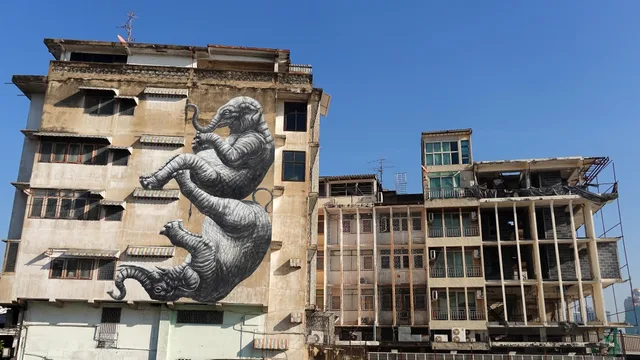
The signature work is by ROA, a Belgian artist. He is known for his monochrome compositions, which give his subjects a striking sense of depth. On the wall of a riverside building, he painted two elephants in black and white, upside down. These elephants have become the street's landmark. Just past Wat Pathum Khongkha, the Romanian artist Aitch covered the entire side of a dilapidated shophouse with a large floral composition in shades of pink. A few years later, the mural already looked badly faded. Its fate is a reminder: these works are ephemeral.
So Song Wat Street Art is neither a single work nor a site with official boundaries. It is an open collection. Newer paintings are added, while others fade away. During Bangkok Design Week in 2026, the HUGS Songwat building was covered with graffiti. At ground level, decorated manhole covers were designed for the street. Looking at these walls means spotting several successive layers.
ROA's mural acted as a trigger. It drew attention to the street. Today, people come here to take selfies. In 2023, Time Out magazine named Song Wat Road among the forty "coolest" neighbourhoods in the world. Cafés, galleries and shops are moving into the old shophouses and warehouses. Design and light events follow one after another. The Ministry of Commerce even wants to make it a new Bangkok landmark.
Yet Song Wat remains a lived-in neighbourhood. The Thai authorities point this out: here you will find old houses, shrines, workshops and contemporary art spaces. The murals are one layer among many in a living neighbourhood.
Remember this: born of a festival in 2016, these fragile paintings have offered a fresh view of a street laid out under Chulalongkorn, and ROA's elephants remain its symbol.
Photo : © Eric Monteil
Source: JARUK