
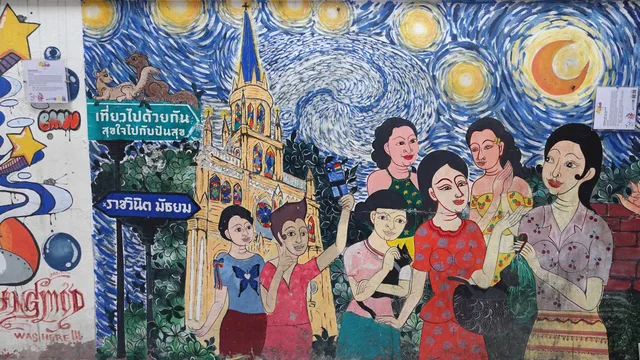
Talat Noi Street Art
Samphanthawong · BangkokWelcome to Talat Noi Street Art. You are in an old merchant quarter of Bangkok, on the east bank of the Chao Phraya. Here, the murals do not form a single work. They make up a scattered trail, spread through the lanes.
Talat Noi means "little market". It is an old Chinese community, south of Yaowarat, Bangkok's great Chinatown. Over time, the quarter has welcomed Catholic Portuguese, Vietnamese, then Hokkien, Teochew and Hakka Chinese. When it first took shape is a matter of debate. Some date it to the founding of Bangkok, others to the Ayutthaya period.
The quarter lives from the trade in steel, mechanical parts and second-hand engines. Workshops fitted with lathes still operate beside the hardware shops. Engine blocks are stacked in front of the façades. This is not a stage set: it is the daily life of a working craft quarter. And it is this life that gives the paintings their character.
It all began in January 2016, with the Bukruk festival, devoted to the urban arts. It invited Thai artists and artists from thirteen countries, notably from Europe, to paint several walls in the city. Some of these works spread around Talat Noi. The quarter's first paintings date from this festival. Others, often by local artists, have been added over the years.
On Song Wat Road, close by, the festival left its most striking pieces. The Romanian artist Aitch painted a large pink floral composition there. ROA depicted two upturned elephants, in monochrome. Aryz painted two deconstructed bicycles, whose parts seem to be coming apart on the wall. The Romanian artist Saddo, for his part, painted a composition of birds.
The paintings cover old shophouses, with a shop on the ground floor and living quarters upstairs, as well as warehouse walls. Their quality and tone vary a great deal. You will find amateur works alongside more modern and radical pieces. That is because the whole has grown through successive additions, without any single commission.
Near the Rong Kueak shrine, a Hakka place of worship on the riverbank, several works draw on Chinese culture. The artist Taeogawa painted Caishen there, the Chinese god of wealth. Studio Dialogue chose a retro style, inspired by Chinese propaganda.
Scrap metal becomes art too. The local artist Len painted the walls of a former car parts warehouse, now the Mother Roaster café. His compositions incorporate the window shutters and used parts. On a roundabout in Soi Wanit 2, the craftsman Heng Seng Junior assembled a statue of Bumblebee, the Transformers robot, from scrap from the neighbouring workshops. And a rusting car, abandoned in a lane, has become a symbol of the quarter, though no one ever conceived it as a work of art.
Since then, the quarter has changed. Cafés, galleries and shops are moving into the old buildings. In 2023, Charoenkrung–Talad Noi became the first "creative district" of Bangkok Design Week. This transformation has sparked a debate about gentrification, that is, the transformation of a working-class neighbourhood by the arrival of better-off residents. The question is how old and new residents can live side by side.
These works are also fragile. Some of the 2016 paintings have already faded. Every year, some paintings fade away, and others appear.
Remember this: Talat Noi Street Art is neither a museum nor a collection. It is a way of looking at an old Chinese quarter, where craftspeople and visitors cross paths every day, among works destined to disappear.
Photo : © Eric Monteil
Source: JARUK