
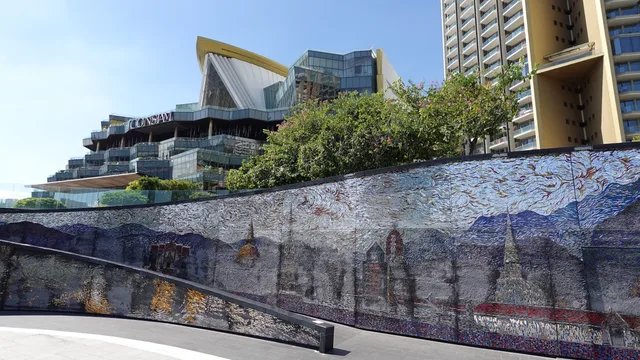
ICONSIAM
Khlong San · BangkokWelcome to ICONSIAM, on the west bank of the Chao Phraya River, in Bangkok. You are on the Thonburi side, opposite the historic centre of the capital. This is not an ancient monument. It is a recent complex, opened in 2018, and it has already changed the face of the city.
ICONSIAM brings together, on a single site, a large shopping centre, two luxury residential towers and a park that opens onto the river. You can live here, shop, eat, see a show or stroll along the water. The project grew out of an alliance between three Thai groups. The complex is inaugurated on 9 November 2018. Princess Sirindhorn presides over the opening ceremony. In 2023, an extension building, named ICS, completes the ensemble.
What you notice first, from the river or from the street, is a long glass wall. This is the façade of ICONLUXE, the area devoted to luxury brands. The glass folds in a zigzag for around three hundred metres. These folds are inspired by the krathong, the floating offering made of folded banana leaves. A familiar gesture is thus carried over to the scale of a contemporary building. And this façade does not rest on the ground: it hangs from the roof structure of the building.
ICONSIAM stands out for the place it gives to culture. Its designers built it around Thainess, the quality of being Thai. It is an identity made up of history, beliefs, craftsmanship and a way of life. The central upper part of the building represents the prow of a flagship facing east. It recalls General Taksin's arrival by river at Thonburi, in 1767. It was on this bank that he moved the capital of Siam and had himself crowned king.
An art trail, the Art Hunting Journey, invites you to discover eight major works, from the ground floor up to the seventh floor. Four golden pillars, sixteen metres tall, by the National Artist Preecha Thaothong, tell the country's story since Ban Chiang. The trail ends on the seventh floor, in the Suralai Hall. There, a giant collage of more than thirty-five thousand images shows the many faces of Thailand. From the opening, the complex called on more than a hundred artists. On the fourth and fifth floors, ICONCRAFT brings together the work of more than eight hundred artisans, designers and communities from across the country.
On the ground floor, SookSiam is devoted to the arts, culture and cuisine of Thailand's seventy-seven provinces. Its stalls evoke the country's regional diversity. A small indoor floating market is one of its most visible features. On the sixth and seventh floors, two terraces offer wide views over the river and the eastern bank of Bangkok.
The complex has also transformed the city. Khlong San and Charoen Nakhon were quiet neighbourhoods. They have become a hub of the capital. In 2015, even before the opening, ICONSIAM's owners proposed a public transport line to serve the site. Today it is the Gold Line, an automated light metro, in service since 2020. The river remains the other main gateway, with four piers built on the site. This transformation raises concerns among some residents, and a debate about inequality from the very opening. In the world of retail, recognition is broad: in 2019, ICONSIAM is named the world's best shopping centre.
Remember that ICONSIAM, a place designed for commerce, showcases the art, the craftsmanship and the provinces of the country. It bears witness to the way contemporary Thailand tells the story of its heritage.
Art Hunting Journey: hunting for artworks at ICONSIAM
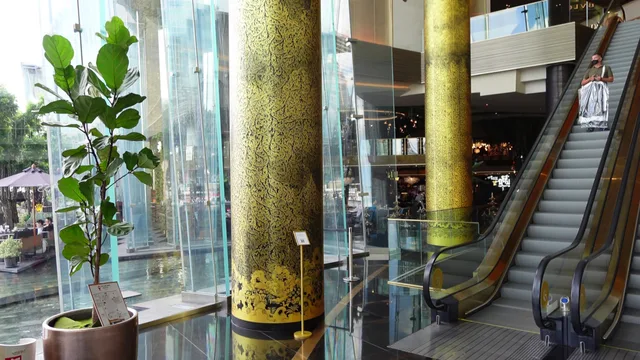 1Symbols of Suvarnabhumi embody the light of wisdomPreecha Thaothong · 2018
The visit begins on the ground floor, in the ICONLUXE area, before “The Symbolic Inscriptions of Suvarnabhumi, Light of Wisdom”, a creation by Professor Emeritus Preecha Thaothong, who has been honoured with the title of National Artist of Thailand. Sixteen metres high, four gilded columns rise at the main entrance of ICONSIAM, facing the Chao Phraya. Their extraordinarily meticulous decoration combines grace of line with a sense of power and groundedness. Each column unfolds a chapter in the history of Suvarnabhumi, a vast historical and cultural sphere of South-East Asia, which the work places under the sign of Thailand. Their motifs follow the thread of the cultures and civilisations that succeeded one another in the region, from the Ban Chiang period to the present day. The first stage of the trail, the work serves as a symbolic threshold to the artistic world of ICONSIAM and welcomes visitors from all backgrounds.
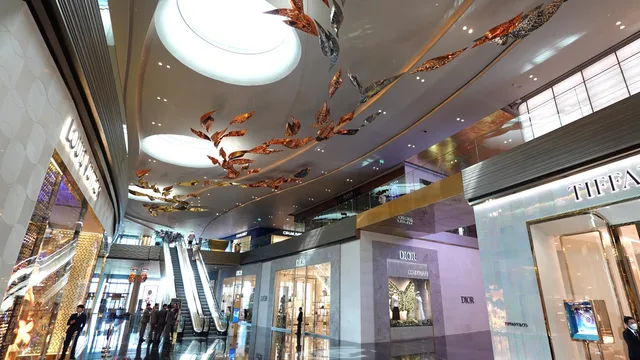 2Mae NamStudio d’art britannique Haberdashery · 2018
When water becomes sculpture: the flames of the Kanok in three dimensions. A few steps from our first stage, still in the ICONLUXE area, look up: an immense suspended sculpture comes into view. It is the work of Haberdashery Studio, a British art studio known worldwide. Here the artist revisits a classic ornament of Thai art, the Kanok Plæo, whose scrolls recall flames. The motif takes on relief and is rendered in reflections of silver, gold and copper. The undulations of the piece and the light shimmering on its surface are inspired by the gleam of ceramic tiles reflected in water. Named “Mae Nam”, “the river” in Thai, the work conveys the energy and continuous flow of the river that runs at the foot of the building. It also expresses the architectural and artistic identity particular to ICONSIAM.
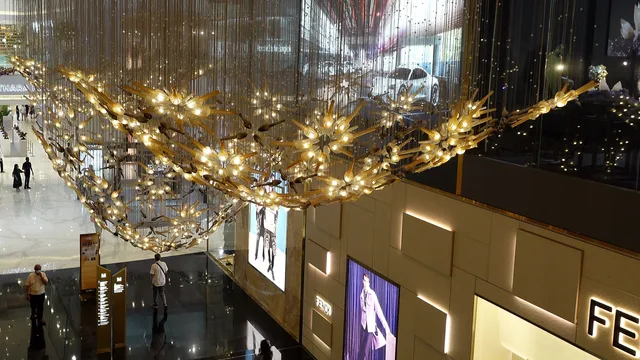 3Phuang Malai: The Chandelier of Kindness and AffectionPetra Junová · 2018
Phuang Malai: a chandelier paying tribute to Thai hospitality. On leaving the suspended sculptures of Mae Nam, look up at the ceiling of the passage linking ICONSIAM to ICONLUXE. A monumental glass chandelier hangs there: a unique piece conceived by Petra Junová for LASVIT, a Czech house specialising in the design and manufacture of works in glass. The work pays tribute to Thai hospitality, to that sense of welcome and generosity whose reputation has spread far beyond the kingdom’s borders, helping to earn it the nickname “Land of Smiles”. To design this chandelier, the designer drew on the phuang malai, a garland of flowers traditionally woven in Thailand, notably from jasmine and dok rak (calotropis), two flowers associated with affection and kindness. Hanging above passers-by, the chandelier transposes this gesture of welcome into a monumental contemporary creation. Like a garland offered to every visitor, it evokes the warmth and generosity of Thai hospitality.
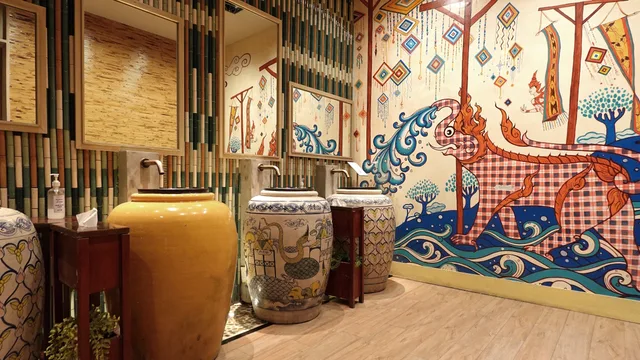 4Jars and murals: a journey through the regions of ThailandWasinburee Supanichvoraparch · 2018
Among the places at ICONSIAM that have caused a stir on social media are, surprising as it may seem, its toilets. On each floor of the shopping centre they follow a decorative theme specific to their zone, to the point of becoming veritable small galleries. This approach has been rewarded several times: the title of “Best Toilets in Bangkok” in 2019, then the ASEAN Public Toilet Standard award in 2021, granted by the Department of Tourism of the Thai Ministry of Tourism and Sports. On the ground floor (level G), those in the SookSiam zone are particularly worth a detour, especially the areas devoted to the Central region and the North-East (Isan). Craftsmanship and artistic creation combine there to introduce visitors to the traditions particular to each region of the country. For the fit-out, ICONSIAM turned to Wasinburee Supanichvoraparch, heir to Tao Hong Tai, the historic ceramics workshop of Ratchaburi. The artist himself shaped the jars using ancestral methods, then decorated them by hand, motif by motif. This painstaking work keeps a centuries-old craft alive and gives rise to unique pieces, steeped in history and culture. On the walls, the collective Hooker’s Green has created contemporary Thai paintings. Each space has its own composition, drawing on the cultural特点 of the region it evokes. These unexpected details invite you to pause, take out your camera and capture, in a place where one would hardly expect it, glimpses of a Thai heritage that deserves to be preserved and passed on.
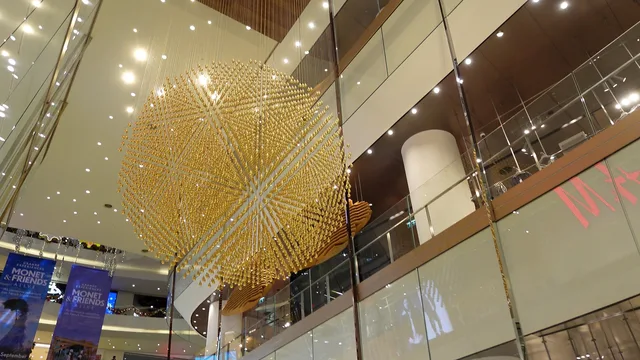 5Thong Yot (Golden Teardrop)Arin Rungjang · 2018
Arin Rungjang’s metal work “Thong Yot” highlights a Thai identity shaped by cultural intermingling. Suspended above the central gallery on level M of ICONSIAM, this monumental brass sculpture by the Thai artist Arin Rungjang takes the form of a traditional sweet, the thong yot. The work was shown in the Thai Pavilion at the 55th Venice Biennale, in 2013, under the title Golden Teardrop. A sweet from elsewhere. In Thai, thong yot (ทองหยอด) means “golden drops”: thong (ทอง), “gold”, evokes the bright yellow colour of the dessert, a symbol of wealth and prosperity, while yot (หยอด), “to pour drop by drop”, describes the gesture of letting the batter fall into boiling syrup. Made from egg yolks, sugar and a little flour, thong yot is one of the nine auspicious Thai desserts. It is offered in particular at weddings and house-warmings to wish lasting prosperity. Its history is traditionally associated with the court of Ayutthaya in the 17th century and with Maria Guyomar de Pinha, of Japanese, Portuguese and Bengali descent, who is credited with introducing several Portuguese-inspired sweets into Siamese cuisine. The wife of Constantine Phaulkon, a Greek adventurer who became one of the most influential advisers to King Narai the Great, she is said to have helped adapt European recipes to local ingredients and customs. Under Narai’s reign, Ayutthaya experienced a period of intense diplomatic and commercial exchange, in contact with the European powers and Asian trading networks. Taking this dessert as his starting point, Arin Rungjang revisits in three dimensions a significant episode in Siamese history. He shows how traditions meet, overlap and eventually merge into one another. The choice of material is part of this approach: the piece was made in brass at a foundry traditionally devoted to the making of Buddhist statues. Its making thus brings foreign influences into dialogue with skills deeply rooted in Thai culture.
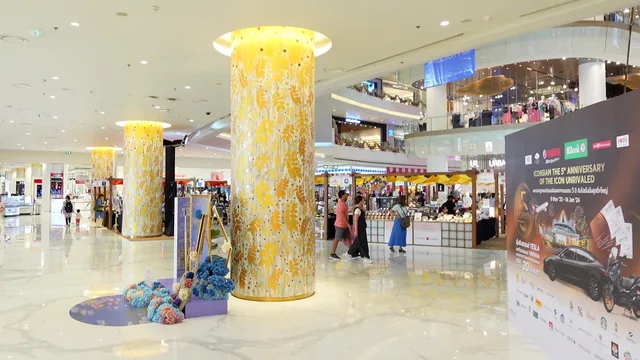 6Pillars of ProsperityThavorn Ko-Udomvit · 2018
Head to levels M and 1 of ICONSIAM to discover eight “Pillars of Prosperity”, entirely covered in gold, and their plant imprints. They are the work of Professor Thavorn Ko-Udomvit, a Thai printmaker known far beyond the kingdom’s borders for his mastery of engraving. The decoration of each column derives from imprints of leaves taken from lucky trees of Thai tradition, including the pradu and the khun, or golden shower tree. Their gilded veins, playing with the light, express the close link that Buddhism establishes between the Dharma, that is, the teaching of the Buddha, and the natural world. Gleaming and meticulously composed, these eight pillars deserve a stop: here contemporary art meets the beliefs and traditions of Thailand.
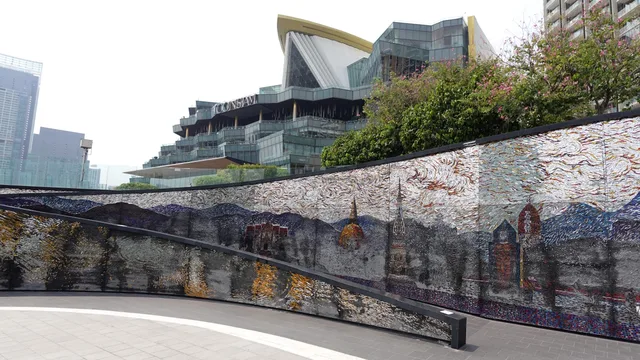 7Light of SiamSitthiwut Yawichai · 2018
Art does not stop at ICONSIAM’s doors. Conceived as a public art venue, the complex also displays open-air works such as “Light of Siam”, a coloured-glass wall with Impressionist accents. On the terrace of ICONSIAM Park (accessed via the Apple Store and Nike), on the second floor, “Light of Siam” (Saeng Siam) stretches over 60 metres. This monumental mural is the work of Sitthiwut Yawichai, a young Thai artist. For this Impressionist-inspired composition, he revisits coloured-glass work using present-day techniques. This craft belongs to the Chang Sip Mu, the “ten categories of artisans” who perpetuate Thailand’s traditional arts and crafts. Long associated with Buddhist art, the technique is now rarely practised. The work draws its originality from natural light. From morning to evening, shadows and reflections shift and alter its appearance. From one hour to the next and from one viewpoint to another, each visitor reads it differently.
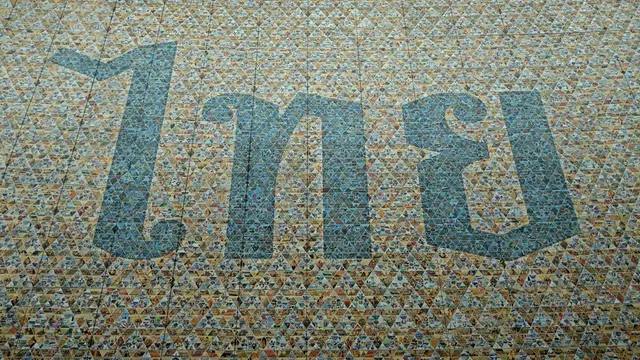 8ICONSIAM “The Artisans” (The Strength of Thai Unity)Prateep Suthathongthai · 2018
The final stage of the trail devoted to ICONSIAM’s signature works, “The Union of the Forces of Thai Identity” occupies the Suralai Hall on the 7th floor. This immense composition was created entirely using the collage technique. It is the work of Assistant Professor Prateep Suthathongthai, whose practice spans printmaking and photomontage. A true culmination of the trail, it brings together in a single image the many faces of Thai identity. Architectural and decorative elements specific to ICONSIAM sit alongside portraits of men and women, each of whom embodies a facet of the country’s cultural heritage. No fewer than 35,000 photographs make up this mural, 10 metres high and 27 metres wide. At its centre stands a short but deeply meaningful word, “ไทย” (Thai), whose lettering blends ancient inspirations with contemporary lines. All around it, motifs borrowed from traditional Thai textiles are reinterpreted in a resolutely contemporary graphic style.
Photo : © Eric Monteil
Source: JARUK