
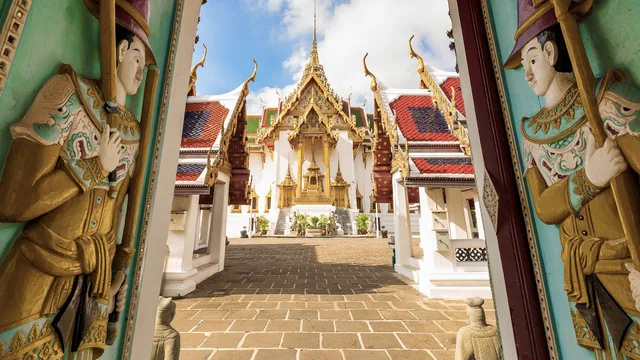
Dusit Maha Prasat Throne Hall
Phra Nakhon · BangkokWelcome to the Dusit Maha Prasat Throne Hall, at the heart of the Grand Palace in Bangkok. It is one of the palace’s great royal halls. It is also the place where the kings and queens of the Chakri dynasty lie in state, between their death and their cremation.
The story of the hall begins with destruction. On this spot once stood the first throne hall of the capital. Struck by lightning, it was completely destroyed by fire. King Rama the First, the first sovereign of the Chakri dynasty, decided to rebuild on the same spot, at the end of the eighteenth century. To build his hall, he looked to the palaces of Ayutthaya, the former capital of the kingdom. The hall is therefore among the oldest buildings in the Grand Palace.
Look at its shape. The hall follows a cross-shaped plan with four equal arms. The four arms extend from a shared centre, above which the spire rises. The building has only one storey. Its height comes from its roof and from its base, which is nearly three metres high. This base raises the hall, and those who stand within it. To the north, a porch projects outwards. It is used for royal appearances.
The spire is not mere decoration. It marks rank. The word prasat refers to a building of royal honour, recognisable by its roof crowned with a spire. Here, the very shape of the roof expresses the dignity of the hall. The name Dusit refers to the Tusita heaven. In Buddhist tradition, it is one of the celestial paradises, where the future Buddha dwells before his final birth on earth. The hall is regarded as a model of royal architecture from the first Chakri reign.
At the centre of the hall stands the main throne, inlaid with mother-of-pearl. Above it rises a nine-tiered white parasol, the emblem of sovereignty. Since the reign of Rama the Fourth, an image of Phra Kampuchat, the deity who guards this parasol, has been placed there. The throne thus stands under the protection of a deity, and beneath the very emblem of kingship.
At first, the hall is used for governing. Rama the First holds his audiences here and deals with the affairs of the kingdom. Later, Rama the Third gathers monks here to revise the canon of Buddhist scriptures. In 1911, King Vajiravudh, Rama the Sixth, still holds a public audience here, on the throne of the north porch.
But from the first reign onwards, the hall also takes on another role. The bodies of high-ranking princesses lie in state here before their funerals. Then, on the death of Rama the First, his own remains lie in state here. This act establishes a custom: the kings who follow him rest here in their turn. Over time, this becomes the hall’s main role. The body is placed in a funerary urn, the kot, set on a decorated pedestal. On the morning of the cremation, a farewell ceremony is held here, before the procession leaves the palace.
This role has been seen very recently. After the death of King Bhumibol, in 2016, his body lies in state in the hall for a year. Up to thirty thousand people a day queue to pay their respects. In 2025, the hall once again hosts royal funeral rites: those of Queen Mother Sirikit, who died on the twenty-fourth of October 2025. The public is admitted every day to pay their respects before the urn. Her cremation is planned for the end of 2026.
Remember this: built for governing and receiving, the Dusit Maha Prasat Throne Hall has become the place where kings and queens rest before their cremation. In a single building, it brings together power, mourning and the memory of an entire dynasty.
Photo : © Internet
Source: JARUK