
Wat Phra Kaew
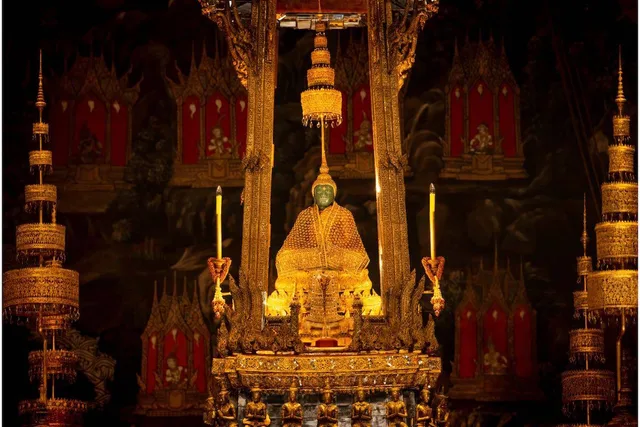
Phra Nakhon · BangkokWelcome to Wat Phra Kaew, the royal temple of the Grand Palace in Bangkok. It is often regarded as the most important temple in Thailand. It was built to house a unique image, the Emerald Buddha. It is this statue that gives the place its common name.
This place is not a monastery. No monks or nuns live here. It was once the private chapel of the kings and their court. What you see is not a single building, but a group of buildings brought together within one enclosure.
The Emerald Buddha is a statue of modest size. It shows the Buddha seated in meditation. Despite its name, it contains no emerald. It owes its name to its green colour, the colour of a hard stone whose exact nature is still debated. No one knows where, when or by whom it was carved.
The image enters history in 1434, in the kingdom of Lan Na. In Chiang Rai, lightning strikes a chedi, a reliquary monument, and reveals a statue covered in stucco. The abbot removes this coating and finds a figure carved from green stone. Two years later, King Samfangkaen wants to bring it to his capital, Chiang Mai. According to tradition, the elephant carrying it refuses that road and, of its own accord, takes the road to Lampang. This is seen as a divine sign, and the image stays in Lampang for some thirty years.
King Setthathirath, ruler of Lan Xang, a neighbouring Lao kingdom, then seizes it. He makes it his palladium, the sacred object that protects his person and his power. The statue then stays in Vientiane. It is there, at the end of the eighteenth century, that General Chakri, in the service of King Taksin, takes it back. Taksin keeps it for about five years at Wat Jaeng, today's Wat Arun.
After Taksin is deposed, General Chakri becomes king under the name Rama the First. He founds a new dynasty and a new capital, Bangkok. There he has the Grand Palace built and, within its walls, this temple. Work begins in 1782. In 1785, the image is installed in the ubosot, the ordination hall. The temple, the palace and the capital are born together.
In the ubosot, the image does not rest on a simple altar. It is set high up, beneath a busabok: a gilded pavilion topped by a spire, with a roof rising in five tiers.
To the north of the ubosot, a raised platform lines up several major buildings. Here stands the Phra Si Rattana Chedi, the largest chedi in the temple, then the Phra Mondop, a square pavilion. The Prasat Phra Thep Bidon houses the statues of the kings of the Rattanakosin period. The two golden chedis built by Rama the First for his parents complete the line. Here, Buddhist devotion meets the veneration of the royal lineage.
The cloister surrounding the whole complex is covered with murals. They tell the Ramakien, the Thai version of the Ramayana, the Indian epic of Prince Rama. The cycle has one hundred and seventy-eight sections and runs all the way round the cloister: you follow the epic as you walk. These paintings date back to the reign of Rama the First, but they have been restored and repainted several times.
The most visible rite is the changing of the Emerald Buddha's adornments. It takes place three times a year, at the turn of the hot season, the rainy season and the cold season. The King himself climbs up to the image, removes the crown of the season that is ending, purifies it with lustral water, then puts on the new crown. Brahmins close the ceremony with a procession around the sanctuary, by candlelight.
The key thing to remember: Wat Phra Kaew is neither a monastery nor a mere monument. It is the sanctuary that the kings of Bangkok built within their own palace to keep an image from the north, passed from kingdom to kingdom, which the King still adorns with his own hands as the seasons turn.
Photo : © Internet
Source: JARUK