
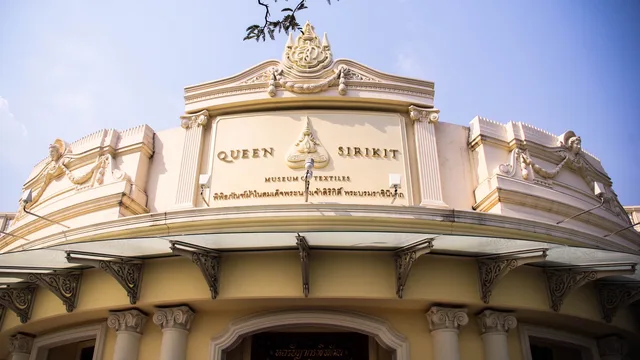
Queen Sirikit Museum of Textiles
Phra Nakhon · BangkokWelcome to the Queen Sirikit Museum of Textiles, the museum of textiles and dress housed within the grounds of the Grand Palace in Bangkok. Here, you discover the fabrics of the court, the wardrobe of a queen, and the Thai dress she helped to create.
This building was not built to be a museum. It is called the Ho Ratsadakon Phiphat. It is an administrative building from the late nineteenth century, raised during the reign of King Chulalongkorn, also known as Rama the Fifth. At that time, the palace was not only a residence: it also housed the ministries of the kingdom. For many decades, this building was home to the Ministry of Finance, in other words the Royal Treasury.
So nothing destined it for textiles. Its new life comes from the work of a queen. Queen Sirikit, wife of King Bhumibol Adulyadej, devoted a large part of her work to the country’s weavers and craftspeople. According to the museum’s curator, it all begins during a visit to Na Wa district, in Nakhon Phanom province. There, the queen notices the silk wrap skirts worn by the local people. From this glance at an everyday garment grows the ambition to support the weavers. In 1976, she founds the SUPPORT foundation, to encourage traditional Thai craftsmanship.
In 2003, the Finance building stands empty. The queen asks to use it for a textile museum, and the king grants her request. The interior is completely refitted. Behind the nineteenth-century walls come galleries, storerooms to protect the fabrics, a library, an education workshop and a lecture hall. The visit unfolds over two floors. The museum also houses Thailand’s first textile conservation laboratory. Here, objects are stabilised, cleaned and repaired to slow their deterioration.
The museum opens its doors in 2012, the year of the queen’s eightieth birthday.
At the heart of the collections, you find the Thai dress of royal fashion, the chut thai phra ratcha niyom. It is a set of eight styles of outfit, created by the queen as Thai national dress. The museum dates them to 1960. These outfits, worn by the queen herself, draw on the traditions of the court.
The other major collection is the queen’s Western-style wardrobe. For her official outfits, she had European-cut garments tailored from Thai fabrics, notably those of the weavers supported by her foundation. Her official outfits thus served to promote the country’s weaving. The French couturier Pierre Balmain played a central role in this approach, over twenty-two years of collaboration. These outfits span several decades, from 1960 to 2000.
The museum’s view reaches beyond Thailand. It collects, displays and conserves textiles from Southeast Asia, South Asia and East Asia, both old and contemporary. The focus remains on the textiles of the Thai royal court and on those linked to the queen.
Queen Sirikit, who became Queen Mother, died in 2025. From the twenty-seventh of October 2025, entry to the museum becomes free as a tribute, during the period of mourning. The place she had wished for then becomes a place of remembrance. People come to see the clothes she wore and the fabrics she supported.
Remember this: this museum carries on the work of a queen who supported the weavers of the countryside. She made Thai weaving part of royal representation, in a national dress as much as in an international wardrobe.
Photo : © Internet
Source: JARUK