
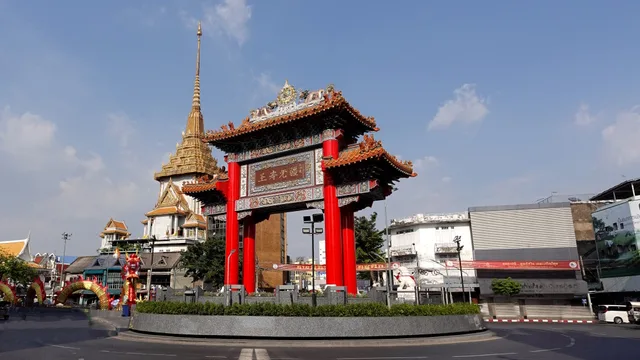
Samphanthawong District
Samphanthawong · BangkokWelcome to Samphanthawong District, Bangkok’s Chinatown. The district stretches along the east bank of the Chao Phraya River. It is the smallest in the country by area. It is also one of the oldest parts of the city, and one of its great centres of trade since its founding.
Its story begins in seventeen eighty-two. That year, King Rama the First founds a new capital on the east bank of the river. On the land chosen for the future Grand Palace lives a Chinese community, the Teochew. The king has them moved to Sampheng, outside the walls of the city under construction. So the Chinese quarter is born at the same time as the capital. The reasons for this move remain hard to establish. But from the very beginning, the place of the Chinese in the city is a choice made by royal power.
A small road then links this new settlement to the walled city. This is Sampheng Lane, the first street of Chinatown. Known today as Soi Wanit One, it is still a narrow, pedestrian street, given over to wholesale trade. The quarter itself does not stay on the margins for long. By around eighteen fifty, it is fully absorbed into the inner city. In just a few decades, it moves from the edge of Bangkok to its centre.
In the second half of the nineteenth century, Sampheng becomes very crowded. Its buildings are flimsy, and fires are frequent. These fires clear space for new roads, laid out on the orders of King Chulalongkorn, Rama the Fifth. Yaowarat Road, the main artery of Chinatown, dates from this period. It is a little over one and a half kilometres long. Its name means ‘young king’, in honour of a prince. According to one tradition, its winding course recalls the body of a dragon, which is said to bring good fortune in business. Along this road and the streets nearby, some houses still keep an original structure dating from Chulalongkorn’s reign.
Several of the district’s temples are older than Bangkok itself. They date back to the time of the Kingdom of Ayutthaya. The most important for the history of the quarter was called Wat Ko, the ‘island temple’, because canals surrounded it. It is restored under the direction of Prince Samphanthawong, nephew of Rama the First. Under Rama the Fourth, it is given a new name in tribute to this prince. The district, in turn, took its name from the temple.
At Wat Traimit, in the sub-district of Talat Noi, you will find the Golden Buddha. This solid gold statue was once covered in stucco. The temple received it in nineteen thirty-five. Since twenty ten, it has been housed in a large building.
Chinese trade has driven the life of the quarter since Bangkok’s earliest days. Yaowarat Road is known for its gold shops. Around forty line the main road, and more than a hundred are spread across the quarter. Hence its nickname, the ‘Golden Road’. The quarter is also home to the largest and oldest market in Thailand for joss paper and Chinese offerings.
This has not always been its image. At the end of the nineteenth century, Sampheng was associated with gambling houses, opium dens and brothels.
Today, the Chinese population has blended into Thai society. Yet the quarter keeps its Chinese culture, in its food, its crafts and its religion. Chinese New Year is when this is most visible, with large celebrations on Yaowarat Road. In the evenings and at weekends, shops and stalls crowd along it.
Remember this: Samphanthawong District was born of a royal decision, and its history is bound up with that of Bangkok. Its value lies less in any single monument than in a continuity of ways of life, in a quarter that never stops changing.
Photo : © Eric Monteil
Source: JARUK