
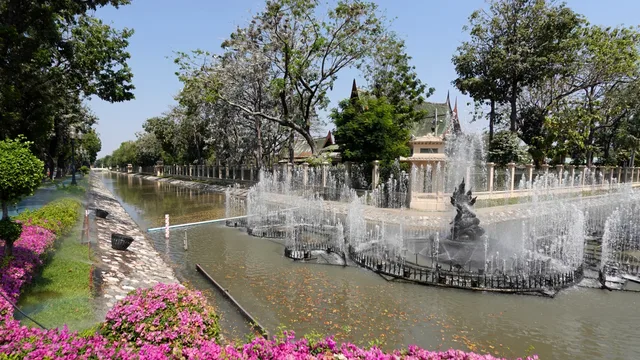
Dusit District
Dusit · BangkokWelcome to Dusit District, north of Bangkok's historic centre. The district takes its name from a royal estate created at the end of the nineteenth century by King Chulalongkorn, also known as Rama the Fifth. With him, Bangkok moves beyond its city walls.
At that time, the capital still lies within Rattanakosin Island. The king decides to settle beyond it. The idea of a residence surrounded by vast gardens comes to him during his journey to Europe, in 1897. Dusit Palace is built between 1897 and 1901. It is not a single building, but a group of residences and gardens. The estate is first called Suan Dusit, the 'celestial garden'. The king makes a habit of living there, and it becomes Wang Dusit, the 'celestial residence'. The Grand Palace, for its part, is now used only for ceremonies.
The best-known residence on the estate is Vimanmek, a large L-shaped teak mansion. It was taken apart on the island of Ko Sichang, then rebuilt in the Dusit garden. It became a museum in memory of Rama the Fifth, and it has been closed to the public since 2016.
At the heart of the estate stands the Ananta Samakhom Throne Hall. Its name means 'the place of the immense assembly'. Chulalongkorn lays the foundation stone in 1908, for the fortieth anniversary of his first coronation. He dies in 1910, and the hall is not completed until 1915. It is a neoclassical reception hall, crowned with a dome. In front of it lies the Royal Plaza, where the equestrian statue of Chulalongkorn faces the building.
This place of the royal court also becomes a place of politics. On the twenty-fourth of June 1932, the plaza and the throne hall are at the heart of the revolution. On the tenth of December that same year, the country's first permanent constitution is solemnly granted in the throne hall. From 1932 to 1974, Parliament sits beneath the dome. 'The place of the immense assembly' then takes on a new meaning. The plaza, for its part, welcomes the crowds. In June 2006, up to a million people gather here to mark King Bhumibol's sixty years on the throne. Today, the throne hall is closed to visitors. It opens only for major royal ceremonies.
The estate also has its own temple, Wat Benchamabophit, built in 1900 on the orders of Rama the Fifth. Its name means 'temple of the fifth king, located near Dusit Palace'. Its ordination hall, the ubosot, is built of white Italian marble. Yet it follows a traditional Thai plan with four gables. The temple houses a statue of the Buddha cast from old brass cannons taken out of service. The monastery is still active: people come here to pray as well as to visit.
Dusit also remains the district of the nation's institutions. The seat of government is here, as is the new Parliament, the Sappaya-Sapasathan, opened in 2021 on the banks of the Chao Phraya.
Remember this: Dusit was born of a king's choice to live outside the old city, and this royal estate saw the birth of the country's constitutional life.
Photo : © Eric Monteil
Source: JARUK