
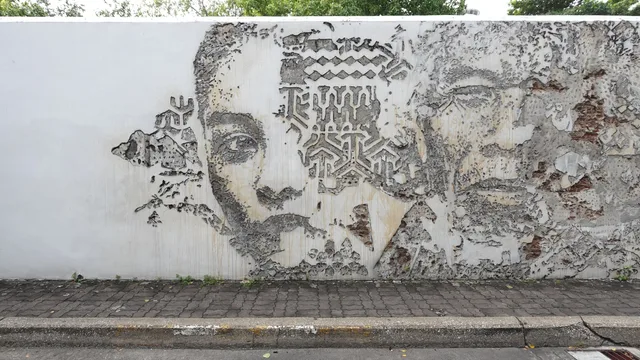
Scratching the Surface by Vhils
Bang Rak · BangkokWelcome to Scratching the Surface by Vhils, a work of public art carved into the outer wall of the Portuguese Embassy in Bangkok, in the district of Bang Rak.
You are in Soi Charoen Krung 30, also known as Captain Bush Lane, on the east bank of the Chao Phraya, the river that runs through the capital. This is no ordinary wall. It belongs to the embassy, right beside its entrance. The Portuguese Embassy is described as the oldest diplomatic mission in Bangkok. Its land was given in 1820 by King Rama II.
Look at the wall. Three lifelike faces emerge from the whitewashed surface. From left to right, as you face the work, you will recognise the American civil rights activist Rosa Parks, the South African president Nelson Mandela and the American president Barack Obama. All three are figures linked to the struggle against segregation and for equality. On the wall of an embassy, they are the ones looking out over the street.
This wall is not painted. It is carved. That is the hallmark of Vhils, the artist name of Alexandre Farto. This Portuguese artist grew up in Seixal, in Portugal. He started out at around the age of thirteen with graffiti, on walls and on trains. He then studied fine art in London, at Central Saint Martins. His technique is unusual. Instead of adding paint, he removes layers of material, with tools such as a chisel. The image is born from what is taken away. The shadows and highlights come from the different depths reached in the wall. In this way, the faces seem to rise out of the very thickness of the wall.
The title sums up this method. Scratching the Surface is the name of a project that Vhils has been pursuing for many years, from city to city. The Bangkok work is one stage in it.
At the heart of the composition are the eyes, and above all the iris. Vhils presents it as what makes us all human, and as something the two cultures share. The gaze becomes the meeting point. The faces also echo azulejos, the decorated glazed tiles that are emblematic of Portuguese architecture. The artist speaks of a kind of symbiosis between the two worlds.
This work grew out of an initiative by the Portuguese Embassy and the Camões Portuguese Cultural Centre in Bangkok. It pays tribute to relations between Portugal and Thailand, which go back more than five centuries. It was conceived as a gift to the city, for residents and visitors alike. A few weeks earlier, in December 2016, Vhils had already carved a mural on the Portuguese diplomatic mission in Macau.
In Bangkok, this is his first work in Thailand. He completes it in five days, in February 2017. The unveiling takes place on the evening of the tenth of February 2017, in front of a few dozen guests. But once unveiled, the work belongs to the street and to those who pass by.
Vhils says he wants to reveal what lies hidden in the wall: the history of the place. This wall has lived through many moments. Scratching the surface is therefore a way of bringing time to the surface. The work does not tell the story of the friendship between the two countries through dates or scenes. It suggests it through the material itself.
Today, the work is a stop on the street art trails of the Charoen Krung area. It is said to be the most photographed piece in the neighbourhood. You can see it freely, by day or by night.
Remember this: on the wall of Bangkok's oldest embassy, on land given by a king of Siam, Vhils carved rather than painted, to bring forth three gazes that speak of the friendship between two countries and of the humanity we all share.
Photo : © Eric Monteil
Source: JARUK