
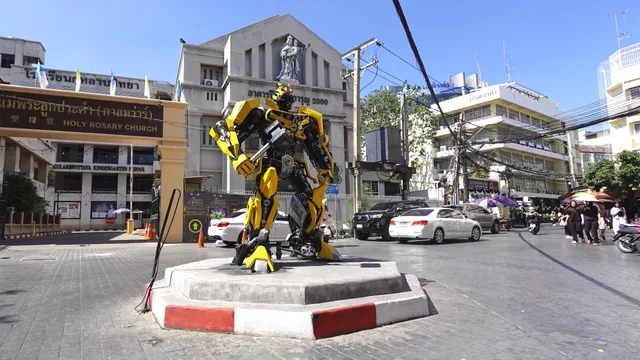
Bumblebee
Samphanthawong · BangkokWelcome to Bumblebee, the large statue of a film robot standing on a small roundabout in Talat Noi, an old merchant quarter of Bangkok. It is not a temple, nor a sacred image, nor a historic monument. And yet this statue helps you understand the neighbourhood around it.
Bumblebee is an English word. It is the name of one of the robots in the Transformers film franchise. The statue recreates this film character on a large scale, in the manner of a replica. People simply call it by the character's name. This name owes nothing to the Thai language or to Thai traditions. The statue belongs to the public art of today. This art borrows its motifs from international popular culture and places them in the street, for everyone to see.
To get here, you walk up Soi Wanit 2, one of the main lanes of Talat Noi. In Thai, a soi is a side street. In this network of passageways that all look alike, a junction marked by such a recognisable figure helps you find your way. So the statue serves as a landmark.
Talat Noi stretches between the river, Charoen Krung Road, Soi Phanurangsi and Khlong Phadung Krung Kasem. A khlong is a canal. The quarter grew thanks to Chinese trade and to its wharves. Over time, it became very densely built, and many migrant workers live here.
Part of the neighbourhood has long been taken up by motorcycle repair workshops and spare-parts shops. Some workshops do more than repair. They assemble salvaged parts to make works of art. This mechanical know-how makes the presence of a giant robot less strange than it might seem. Bumblebee is a figure of a machine, set down in the middle of a neighbourhood of machines.
Since the 2010s, Talat Noi has been presented as one of the main places for street art in Bangkok. This means murals and works made directly on the city's walls. In 2016, the Bukruk festival marked a milestone. It left three large murals on Song Wat Road. In 2020, the movement continued with the Colour of Charoenkrung project. The streets can be explored freely and at no cost, at any hour. In this way, the neighbourhood becomes a kind of open-air gallery.
Bumblebee holds a special place within this whole. It is not a mural, but a three-dimensional sculpture, standing in the centre of a junction. Yet it shares the same principle as the murals: a striking image, placed in public space, that changes the way you look at the street.
Walking accounts describe Bumblebee as both a landmark and a stop along the way. People pause here, take a photograph, then set off again towards the nearby lanes. By November 2023, the statue already features in guides to the neighbourhood. It gives an instantly recognisable face to a neighbourhood whose charm lies rather in an accumulation of quiet details.
This fame also has its critics. One travel journalist describes it as "infamous". He urges walkers not to stop at the statue, but to discover the streets around it instead. This judgement sets a spectacular image, easy to recognise and to photograph, against a neighbourhood whose value reveals itself more slowly.
Bumblebee is not linked to any local tradition. Yet it has taken root in a quarter of wharves and workshops, shaped by metalwork and now a centre of urban creativity. Remember that it bears witness to a living heritage, one that is taking shape before your eyes rather than being handed down from generation to generation.
Photo : © Eric Monteil
Source: JARUK