
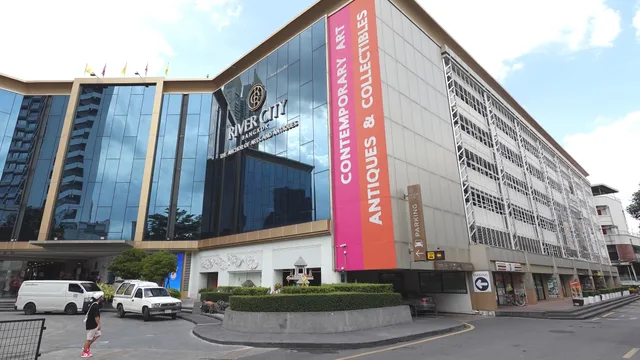
River City Bangkok
Samphanthawong · BangkokWelcome to River City Bangkok, a private centre devoted to art and antiques. You are on the east bank of the Chao Phraya River, in the Talat Noi district of Bangkok. This district is an old area of Chinese settlement in the capital.
The centre opens on the first of December 1984. At first, it is a shopping centre for antique dealers. It is presented as the work of Adisorn Charanachitta, chairman and chief executive of the Italthai Group. According to the operator’s account, the idea comes to him during trips to Europe in the 1980s. He discovers the antiques markets of Paris. He then imagines a centre for antique dealers on the banks of the Chao Phraya.
The design of the building is attributed to Krisda Arunvongse na Ayudhya. He was an architect, a professor, an officer and a politician. A few years after the centre opens, he becomes Governor of Bangkok, from 1992 to 1996. The building he designs is a large, four-storey complex, conceived from the outset as a shopping centre.
Here, the river matters. You can come by car, but also by boat, to the nearby Si Phraya pier. The restaurants and cafés open onto terraces by the water.
River City Bangkok is not a museum. It is a market. Here, old objects are looked at, compared and bought. The shops offer antiques and works of art from Asia and beyond. Alongside them, you also find more everyday crafts, such as silk or made-to-measure tailoring.
At the heart of this activity is the centre’s auction house, RCB Auctions. The lots it sells come from family estates all over Thailand. They include Chinese and Thai porcelain, silverware, sculpture, jewellery and fine art. Pieces long kept in private homes, handed down from one generation to the next, go up for public sale here. They change hands and find new owners.
Over time, the line between commerce and exhibition begins to blur. Galleries move in. The venue hosts temporary exhibitions, organised with international organisations. The first notable exhibition is called Exodus. It brings together images by the photographer Patrick Brown, made with UNICEF. From then on, people come here to look, and not just to buy.
Between late 2015 and early 2016, the centre reopens after a major renovation. The interior spaces take on a contemporary style: glass panels, high ceilings, and black, white and gold.
In 2024, River City Bangkok celebrates its fortieth anniversary. An exhibition traces the history of the place through the figure of its founder. His letters, his personal belongings and the notebooks in which he planned the project are on display. It is housed in RCB Artery, the exhibition space on the first floor. For the anniversary, six galleries also come together in a group exhibition.
That same year, the managing director, Linda Cheng, announces a new direction. The venue aims to become a centre for the arts and culture. Contemporary art, theatre, music, film and antiques are meant to meet here. You can meet artists, and attend talks, screenings and concerts. And people still come to bid at the auctions.
Remember this: born in 1984 as an antiques market, River City Bangkok has kept the heirlooms of Thailand’s families in circulation, and today it is opening up to living art, on the banks of the Chao Phraya.
Photo : © Eric Monteil
Source: JARUK