
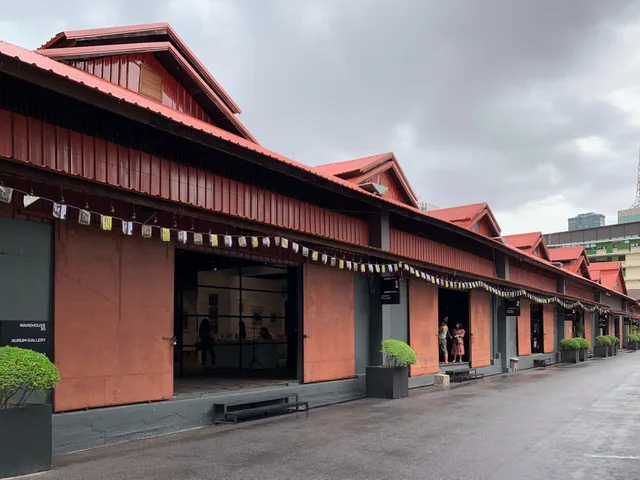
Warehouse 30
Bang Rak · BangkokWelcome to Warehouse 30, in the Bang Rak district of Bangkok. This group of former warehouses became a cultural and commercial complex in 2017. Today it ranks among the city's successful warehouse conversions.
The name simply comes from the address: Soi Charoen Krung 30. In Bangkok, a soi is a side street that branches off a main road, here Charoen Krung Road. So the number thirty is neither a date nor a warehouse number. The lane once had another name, which is still in use: Captain Bush Lane. It recalls John Bush, an English sea captain. King Mongkut hires him in the late 1850s as harbour master of Bangkok.
The site brings together three plots of land. It holds seven warehouses, which are linked to the period of the Second World War. Their exact origin, however, remains hard to establish. According to one account, the Japanese army moves into an area where the warehouses already stand. According to another, it seizes the land to build them, then returns it to its owner in 1945. During the conflict, the Japanese army uses the site for general storage. The buildings are never hit by Allied bombing.
After the war, the land is bought by Manee Chavanich and her husband. The warehouses are still used for storage, notably for machinery and locomotive parts. Around them, the neighbourhood changes. The business district moves away from the river, and the area along Charoen Krung Road loses some of its commercial appeal.
In 2017, the Thai architect Duangrit Bunnag takes over the site. He has already created The Jam Factory, on the other bank of the river. He does not own the warehouses: he rents them. Alongside him, Rungsima Kasikranund, former editor-in-chief of Elle Decor magazine, leads the project. The principle behind the work is simple. The exterior is restored. The interior stays largely as it was. One rule applies to everyone: the original wooden floors must be kept. The spaces remain raw and open. The industrial atmosphere of the war years can still be felt.
The official opening to the public takes place on Saturday the twelfth of August 2017. The warehouses house shops, galleries, cafés, a screening room and a co-working space. At the opening, the Documentary Club runs an eighty-seat screening room. An independent bookshop, Candide, specialises in design and architecture. A café roasts its own beans on a vintage roaster.
Warehouse 30 is presented as an alternative to the big shopping centres. Entry is free. So you can wander through without buying anything.
The choice of site is partly explained by its neighbours. The Grand Postal Building in Bang Rak, home to the Thailand Creative & Design Center, is close by, as is The Jam Factory. Warehouse 30 is part of a wider project: bringing the Charoen Krung district back to life. Duangrit Bunnag chairs a foundation that aims to revitalise the area without gentrification, that is, without replacing residents and small businesses with a wealthier population.
These warehouses are neither a temple nor a palace. They are utilitarian buildings, and even their construction date remains uncertain. Their value lies in what they have lived through: the war, the occupation, the decades of storage. Remember this: at Warehouse 30, the choice was to transform rather than demolish, and this ordinary memory has become the very setting for the cultural life of the neighbourhood.
Photo : © Chainwit. — Wikimedia Commons, CC BY-SA 4.0
Source: JARUK