
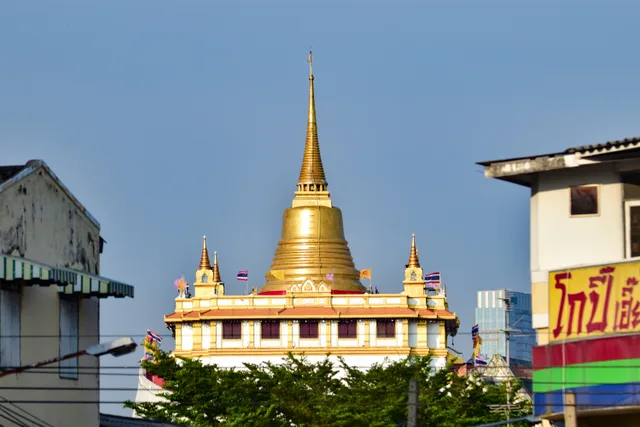
Wat Saket (Golden Mount)
Pom Prap Sattru Phai · BangkokWelcome to Wat Saket (Golden Mount Temple). It is a royal Buddhist monastery in Bangkok. It stands beside the old canals that once encircled the city. Its hill, Phu Khao Thong, the Golden Mount, is crowned with a golden chedi. Its story is an unusual one: a failed building project here became one of the symbols of Bangkok.
The temple is old. It already existed in the Ayutthaya period, under the name Wat Sakae. The first king of the Chakri dynasty, Rama the First, had it restored so extensively that it can be called a refoundation. He also had canals dug around it. In 1783, the Khlong Maha Nak was opened. The monastery then found itself beside this canal and the city's encircling canal.
The name Saket means "washing the hair", implying the royal hair. According to tradition, General Chakri, returning from a campaign in Cambodia, is said to have stopped here to take a ritual bath. He was then raised to the throne in 1782, as Rama the First. To this day, Wat Saket is a royal temple, under the patronage of the monarch.
Lying outside the fortified walls, the monastery became a common place for funerals. In 1820, under King Rama the Second, a cholera epidemic struck the capital. It killed tens of thousands of people. Wat Saket became the main place where the victims were brought. And cholera returned every dry season, for decades. Unable to cremate all the bodies, people left some of them in the open air. Vultures settled on the site for good. The expression "the vultures of Wat Saket" even entered everyday speech.
Now look at the hill. It was never part of the plan. King Rama the Third began a very large monument here: a prang, a temple tower with a slender silhouette. But Bangkok's soft ground, waterlogged by the nearby canals, could not bear the weight. The foundations sank several times, and the monument collapsed while still under construction. All that remained was a great heap of bricks. Local people called it "phu khao", "the mountain". It is this hill, and not the planned tower, that later reigns would go on to develop.
The hill remained unfinished under King Mongkut, Rama the Fourth. It was only completed under Chulalongkorn, Rama the Fifth. In 1878, this king had relics of the Buddha, kept at the Grand Palace, placed at the summit. In 1898, a second deposit added relics from India. And so the monument born of a collapse became a reliquary, an object of veneration for the whole city.
The summit as you see it today dates from 1966. That year, the chedi was covered in a golden mosaic, and four small chedis were built around it. At the summit, worshippers come to venerate the relics and apply gold leaf. At ground level, the monastery also has its ordination hall, the ubosot, with its images of the Buddha and its mural paintings.
Every year in November, at the time of Loy Krathong, the Golden Mount Fair takes place. It lasts around seven to ten days. It opens with a candlelit procession that climbs the hill. The chedi is then wrapped in a long red cloth. At the foot of the mount, the fair then takes on a secular character, with its stalls, traditional games and fairground rides.
To remember: Wat Saket is a living royal monastery, where several layers of history meet: the refoundation by Rama the First, the memory of the epidemics, the failure of a royal building project and the consecration through relics. A failed tower here became the Golden Mount, one of the symbols of Bangkok.
Photo : © กสิณธร ราชโอรส — Wikimedia Commons, CC BY-SA 4.0
Source: JARUK