
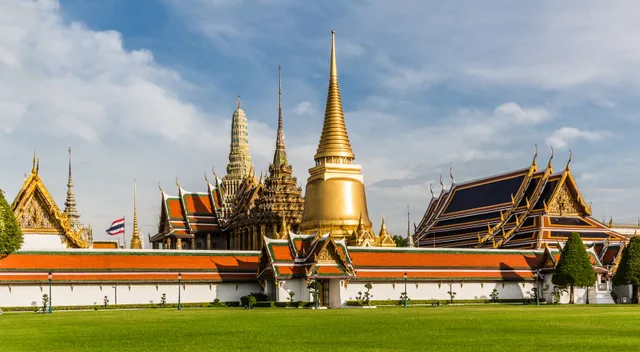
The Grand Palace of Bangkok
Phra Nakhon · BangkokWelcome to The Grand Palace of Bangkok. You are at the heart of the capital, on the east bank of the Chao Phraya River.
In 1767, Ayutthaya, the capital of the kingdom, falls to the Burmese armies. In 1782, Rama the First founds the Chakri dynasty and chooses this bank for his new capital. Work on the palace begins in May. By June, the king crosses the river in a ceremony and moves into his new palace.
Rama the First wants to recall the splendour of Ayutthaya. He takes up the layout of its palaces, with a series of courts. Some of the bricks in the walls even come from the ruins of the old capital. They arrive by barge along the river. Then, for more than two hundred years, the kings add or rebuild buildings. This explains the site's asymmetry and its variety of styles.
The grounds are divided into three courts, from the most public to the most private. The Outer Court housed the civil administration, the army and the treasury. The Middle Court brings together the buildings of state. The Inner Court contained the residences. It was a small town of women, where no man entered, except the king. Today it remains entirely closed to the public.
Within the walls stands Wat Phra Kaew, the Temple of the Emerald Buddha. It is not a monastery: no monks live here. It was the kings' private chapel. Despite its name, the statue is not carved from an emerald. It is probably jadeite, a green stone. It appears in the fifteenth century in Chiang Rai, then passes to the Lao kingdoms. The future Rama the First brings it back from Vientiane. For a long time, it has expressed the legitimacy of the region's rulers. It is dressed in regalia, which it changes with the seasons.
The Dusit Maha Prasat, a throne hall built under Rama the First, follows the rules of traditional Thai style. Its multi-tiered roofs, covered in coloured tiles, rise towards a tall spire. Its name refers to the Tusita heaven, the abode of the bodhisattvas. Indeed, the king is seen as a bodhisattva.
In 1882, a century after the founding, King Chulalongkorn completes the Chakri Maha Prasat. Its marble façade follows the style of the Italian Renaissance. Its roof of coloured tiles bears three Thai spires of seven tiers each. It is nicknamed "the Westerner wearing a Thai hat". The present building is only part of it: for lack of funds, the rear section was demolished during the 1932 renovation.
For around a hundred and fifty years, this palace is both the king's home and the centre of government. Then the kings move to live elsewhere. But the palace remains in use. Royal offices work here, and the great ceremonies take place here, from coronations to funerals. In October 2017, it hosted the funeral of King Bhumibol Adulyadej.
Remember this: The Grand Palace of Bangkok tells the story of two centuries of monarchy, from the legacy of Ayutthaya to European architecture. The kings no longer live here, but it remains the setting for their great rites.
Photo : © Original image: Ninara from Helsinki, Finland. Edit: TSP — Wikimedia Commons, CC BY 4.0
Source: JARUK