
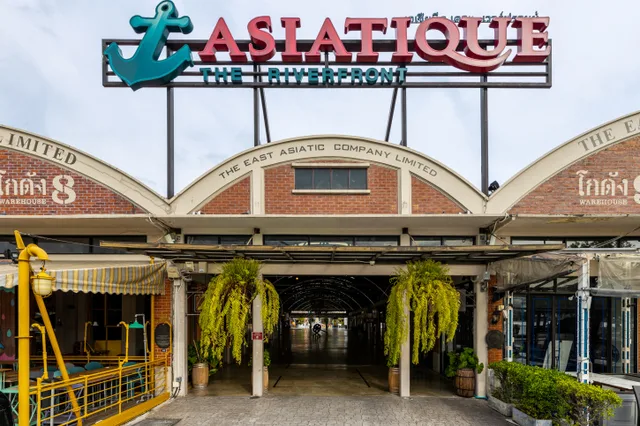
Asiatique The Riverfront
Bang Kho Laem · BangkokWelcome to Asiatique The Riverfront, on the bank of the Chao Phraya River in Bangkok. This vast open-air complex occupies the former docks of the East Asiatic Company, a Danish firm. Here, three memories lie one on top of another: that of a monastery, that of a trading port and that of a place of leisure.
Before the quays, this riverbank belonged to a Buddhist monastery, Wat Phraya Krai. It flourishes during the reign of Rama III. At that time it receives its principal image, entirely covered in stucco. During the reign of Chulalongkorn, Rama V, the temple loses its patrons, falls into ruin and is then abandoned. Yet the statue stays where it is for several decades. In 1935, it is moved to Wat Traimit, another monastery in Bangkok. Today it is known as the Golden Buddha.
The land is then leased to the East Asiatic Company. Its founder is a seaman, the Danish captain Hans Niels Andersen. Having arrived in Bangkok in 1873, he commands the Thoon Kramom, a ship belonging to King Chulalongkorn. In 1884, he founds a trading house dealing in particular in teak. In 1897, he establishes the East Asiatic Company in Denmark.
On the riverbank, the company builds a port: a pier, quays, and warehouses lined up between the river and Charoen Krung Road. What you see first are these warehouses, now home to restaurants. The oldest dates from 1907. They are the main physical trace of the site's history. Of the monastery, by contrast, nothing remains standing.
In 2011, the company TCC Land announces the conversion of the docks. Rather than demolish them, it chooses to keep and restore the warehouses. The complex opens on the twenty-seventh of April 2012, and its name recalls the East Asiatic Company. Goods are no longer loaded here: instead, people stroll by the river in the evening, along a promenade of around three hundred metres. Beside the water, the Asiatique Sky big wheel also turns, standing some sixty metres high.
Moored in front of the warehouses since 2020 is the Sirimahannop. This three-masted ship is a replica of the Thoon Kramom, the royal vessel commanded by Andersen. It is not a relic, but a recent reconstruction. It recalls the bond between the Danish captain and the Siamese court. That same year, the operator relaunches the site under the concept "Heritage Alive", centred on this maritime history. Other attractions have been added since, with no connection to the port: a Disney village, a fossil park and a 9D cinema.
This memory remains selective. It highlights the Danish trading post, and leaves the monastery and the Golden Buddha almost in the shadows. So remember this: beneath the shops and the shows, these warehouses from 1907 still bear the trace of Bangkok's merchant port, built on land that was first consecrated.
Photo : © This Photo was taken by Supanut Arunoprayote . Feel free to use any of my images, but please mention me as the author and may send me a message. (สามารถใช้ภาพได้อิสระ แต่กรุณาใส่เครดิตผู้ถ่ายและอาจส่ง — Wikimedia Commons, CC BY 4.0
Source: JARUK