
Chinatown Night Market
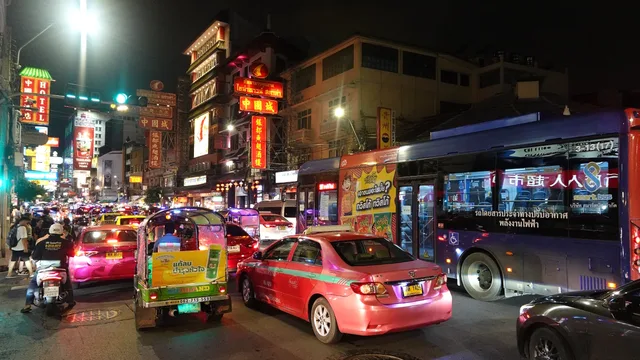
Samphanthawong · BangkokWelcome to the Chinatown Night Market, on Yaowarat Road, the main artery of Bangkok's Chinese quarter. This market has no hall and no enclosure. Its name, common among foreign visitors, refers to the street food that takes over the road every evening. When evening comes, the stalls line up on both sides of the roadway, between jewellery shops and restaurants. To understand this market, then, is to understand a street, and the quarter it has come to stand at the heart of.
It all begins with a move. In 1782, General Chakri becomes king under the name Rama the First. He has the Teochew Chinese community settle in Sampheng, on the east bank of the Chao Phraya. This merchant quarter becomes the home of the Chinese presence in Bangkok.
In the second half of the nineteenth century, the quarter, which is very crowded, suffers many fires. During the reign of Chulalongkorn, known as Rama the Fifth, the destruction makes way for new roads. Yaowarat Road is built between 1892 and 1900. It is about one and a half kilometres long, and around twenty metres wide. With it, the quarter changes scale. This wide road becomes the new centre of Chinese life in Bangkok. Its name means "young king". It is also called the Gold Road, because of its jewellery shops, and the Dragon Road.
The quarter has established itself as a hub of trade, finance and banking. In the past, this street had restaurants, hotels and tea houses, but also brothels and gambling dens. It was a street of pleasure as much as of trade. Today, it is above all its street food that makes its name, so much so that it has become one of the world's great centres of the practice. This food is not a separate activity. It is one of the forms of trade that keep the street alive.
Here, the line between shop, restaurant and stall remains blurred. You can order on the pavement, sit at a table in front of a stall, or leave with a takeaway. The food on offer mixes Thai, Chinese and European cooking. The market does not set itself up away from the city, but right in the flow of the street. The Michelin Guide has, in fact, recognised several places in the quarter. Guay Jub Ouan Pochana, on Yaowarat Road, is known for its kuay chap. Khao Phad Pu Chang Phueak is famous for its crab fried rice.
Yet this street life has been under threat. In April 2017, the Bangkok Metropolitan Administration announces a ban on street vendors across the whole capital. A few days later, it reverses its position. Street food remains allowed on certain stretches of Yaowarat, which is regarded as a tourist hub. But the rules become stricter. Vendors take a one-day course on the law, hygiene and waste management. The selling area is marked out, and each vendor must clean their own spot. At the time, Bangkok had just been ranked the world's best city for street food two years running by the American network CNN.
In December 2019, the city turns Yaowarat Road into a pedestrian street to support tourism. The scheme was meant to be repeated every weekend. The market is no longer simply tolerated: the street is arranged around it. In 2024, the street also appears in the video for LISA's song Rockstar, which raises its profile even further.
Remember this: the Chinatown Night Market is not a monument, but a way of occupying a street. Its evening stalls carry on a long history of trade, which began when the Teochew settled in Sampheng. And its place on the street today rests on a balance between the city's rules and the appeal it holds for visitors.
Photo : © Eric Monteil
Source: JARUK