
Wat Chak Daeng Recycling Center
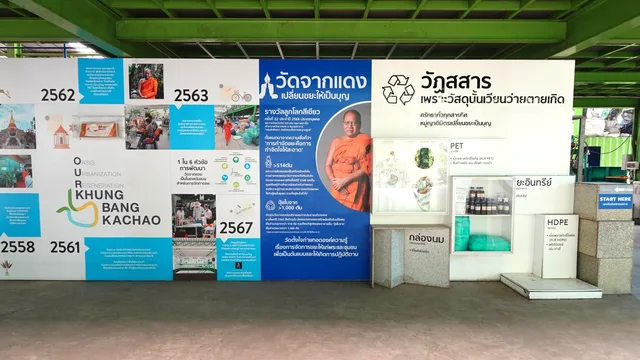
Phra Pradaeng · Samut PrakanWelcome to the Wat Chak Daeng Temple Plastic Recycling Center. You are in a Buddhist monastery in Samut Prakan Province, near Bangkok. Here, a plastic bottle becomes an offering. Given by the faithful, it is turned into thread, and then into a monk’s robe.
The temple stands on the banks of the Chao Phraya. Here the river forms a wide loop, Khung Bang Krachao, a land of orchards and coconut groves. It is described as the green lung of Bangkok. Yet every tide also leaves in front of the temple what the river carries: bottles, plastic bags, branches, pieces of glass. The project was born from this contrast.
Wat Chak Daeng is a common temple, not one of the royal temples. According to the community, it received the royal grant of its consecrated ground around 1787. Its ubosot, the ordination hall, dates from 1858. Its pediment is decorated with blue and white ceramics. In the wihan, the worship hall open to the faithful, stands the monastery’s most revered Buddha image: Luang Pho Hin. It was found during excavations around the old ubosot.
This is also a monastery of study. The monks here study the Abhidhamma, the part of the Buddhist teaching that analyses the mind and phenomena. In 2005, a monk arrived to teach and to manage the temple: Phra Maha Pranom Dhammalangkaro. He found grounds full of waste. Rather than having it taken away, he decided to sort it and manage it on site. He has since become the temple’s abbot.
It all began with composting kitchen scraps and collecting the waste brought in by the tides. Then the sorting grew: plastic bags, glass, paper, cardboard, cans. Around 2018, the temple launched a campaign to collect bottles to make monks’ robes. Partners joined in, including the company PTT Global Chemical and the Chaipattana Foundation, which runs a programme to protect the river loop.
Only the clear plastic of bottles, known as PET, is used to make fabric. The bottles are cleaned, pressed into blocks, and then turned into thread. These fibres are woven with cotton. The result is a cloth in saffron colours. A sign at the temple states that fifteen one-and-a-half-litre bottles are needed for one robe. But a monk’s full attire has three pieces. For a complete set, estimates rise to around sixty bottles.
At the heart of the project lies merit, the good accumulated through virtuous acts. Giving a bottle to the temple is presented as a meritorious act. The woven robe can then be offered to the monks. In this way, it renews one of the oldest gifts in the tradition. For Phra Maha Pranom, this work belongs to the Buddha’s teaching. Sorting becomes a chance to speak about mindfulness, responsibility and detachment.
In this monastery, religious spaces and work spaces sit side by side. Near the ubosot and the wihan, an area is set aside for unloading donated bottles. Baskets and bins are used for sorting. A press crushes the bottles into compact bales. A large warehouse holds the materials waiting to be processed. The monks who study the doctrine are also the ones who sort. And the faithful who come to make an offering often bring bags of bottles.
By early 2020, at least eight hundred sets of robes had been produced. Even so, the faithful’s demand for recycled robes still exceeds the quantities collected.
Remember this: here, the union of an ecological gesture, religious merit and community work is what makes this place unique. A bottle given by a worshipper can return as cloth, worn by the very people who sorted it.
Photo : © Eric Monteil
Source: JARUK