
Khon Learning Center
Bang Pa-in · AyutthayaWelcome to the Khon Learning Center, at Ko Kerd, in Ayutthaya Province. This building is devoted to khon, the masked dance drama of Thailand. It stands within the Ko Kerd Arts and Crafts Centre, in Bang Pa-in District. The Arts of the Kingdom Museum shares the same complex.
Khon is not simply a dance. It brings together music, song, literature, dance, ritual and craftsmanship. Its episodes come from the Ramakien. Its origins are traced back to the Ayutthaya period. So it is in the province of this former capital that you are discovering its treasures today.
The site is run by the SUPPORT Foundation. Queen Sirikit founded it in nineteen seventy-six. At that time, she sees khon in decline. She wants to revive it. She asks for the costumes and props to be remade in the old style, while modernising the performances. Her efforts revive the arts of costume, make-up, dance postures and staging. Every year, young performers are recruited to carry the art forward on stage.
From two thousand and seven, the foundation regularly stages performances known as "royal khon". This building preserves and displays their sets and props. In two thousand and eighteen, UNESCO inscribes khon on the list of the Intangible Cultural Heritage of Humanity. The building celebrates this international recognition.
The Ramakien greets you even before you go in. The pillars of the front balcony bear figures of its characters. So you meet the heroes and demons of the epic before you even step inside.
Inside, the exhibition unfolds over several floors, served by a lift. Here you see large stage sets, masks, costumes, stage chariots called rajarot, and a great many props. Videos trace the history of khon. Members of staff guide visitors.
One room displays the masks of the different characters side by side. Another section shows masks and headdresses of great delicacy. Some masks are made of twenty-two successive layers.
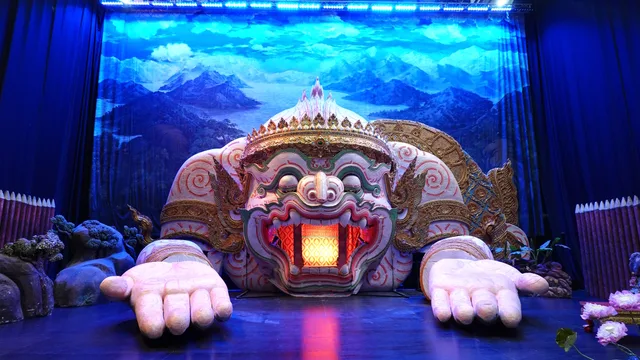
The sets are the most spectacular part of the visit. They were used in the foundation's performances. One stands out in particular: Hanuman swallowing the pavilion. It comes from the Maiyarap episode. It shows the giant monkey holding a pavilion in his mouth. It is so large that you can walk inside this giant Hanuman. Another monumental set, the royal junk, comes from the episode of Phiphek's surrender. The sets for Bali's oath, created for the two thousand and twenty-five season, are shown to the public that very year. Every production involves a true workshop of craftspeople.
For this place does more than display finished objects. It explains how the costumes and masks are made, and how the sets are designed. Choreography, music, costumes and masks are presented together, with demonstrations and interactive displays. You can link a mask to the character who wears it, then to the codified gestures of the dance and to the music that sets the rhythm of its movements.
The building is also a working school, where new generations train in this art. In this way, the objects on display remain bound to a living practice.
Remember this: here, khon reveals itself away from the stage. Masks, costumes and sets bear witness to a revival led by Queen Sirikit, who brought craftspeople, performers and audiences together.
Photo : © Eric Monteil
Source: JARUK