
Tha Rae Catholic Village
Mueang Sakon Nakhon · Sakon NakhonWelcome to Tha Rae Catholic Village, on the northern shore of Lake Nong Han, in Sakon Nakhon Province. You are at the heart of the largest Catholic community in Thailand. The village is also home to the seat of the Archdiocese of Thare and Nonseng, which bears its name.
It all begins in 1884. A French missionary, Xavier Guego, whom the locals call "Keko", leads a few Catholic families living in the centre of Sakon Nakhon. Around twenty families, about a hundred and fifty people, cross the lake. They travel by small boat and on bamboo rafts. They are Vietnamese Catholic immigrants, fleeing persecution in French Indochina. They are looking for a place to live out their faith. The memory of this crossing remains at the heart of the village's identity.
A year later, in 1885, the village receives its first parish priest, Father Joseph Combourieu. A few years after his arrival, he opens a school. It is the forerunner of Saint Joseph Tha Rae School. Today, the school takes pupils from nursery right through to the end of secondary school.
Little by little, the village becomes a centre. In 1950, the Thai part of a vast missionary vicariate, which also covered Laos, takes the name Thare. In 1965, it becomes the Archdiocese of Thare and Nonseng. The village where a handful of families once came ashore is now the heart of a local Church.
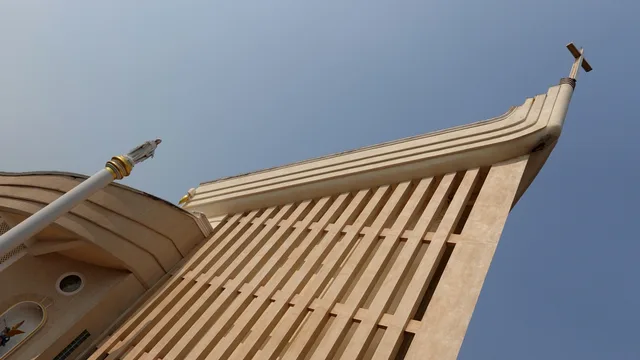
The community's main monument is Saint Michael the Archangel Cathedral. Its outline recalls a boat. This is not mere decoration. The shape was chosen in memory of the ancestors and their crossing of Lake Nong Han. In this way, the story of the founding is written into the architecture. Tha Rae also has four other, smaller churches.
As you walk through the streets, it is above all the houses you will notice. Tha Rae is one of the best-preserved European-style provincial centres in Thailand. The French Indochinese-style houses are recognisable by their arcades, their balconies and their windows. They recall how close French Indochina lay, just across the Mekong. They also recall the Vietnamese origins of some of the residents.
Around 2021, Tha Rae has some fifteen thousand Catholics. It is a very mixed population. There are descendants of Vietnamese, Chinese, Lao and Thai people. There are also groups from the region, such as the Nyo, the So and the Phu Thai. Many families originally lived on the margins. There were uprooted people, former slaves, and even people accused of being phi pop, malevolent spirits. The Catholic mission brought them together as one community.
Faith still sets the rhythm of daily life. Every morning, at around six o'clock, the children go to Mass. On Saturday evenings there is an offering of flowers. On Sundays, the faithful go to church. Yet this practice is part of a local culture that blends Catholic and Buddhist elements.
Residents call their village the "land of stars". Since 1982, at Christmas, they have held the Star Procession. It is inspired by the Star of Bethlehem, which guided the Magi to the infant Jesus. For three days, the houses are covered in decorations. At nightfall, floats bearing illuminated stars make their way through the village. On the lake, boats decked with stars sail by. Priests, religious and volunteers organise the festival. In 2025, the Tourism Authority of Thailand includes it in the Signature Event Thailand programme.
Remember this: Tha Rae is above all a community, born of a crossing in 1884, which made its parish the centre of its life. Its boat-shaped cathedral, its Indochinese-inspired houses and its Christmas stars all tell this story.
Photo : © Eric Monteil
Source: JARUK