
Arts of the Kingdom Museum
Bang Pa-in · AyutthayaWelcome to the Arts of the Kingdom Museum, at Koh Kerd, in Bang Pa-in district, near Ayutthaya. This museum was created at the wish of Queen Sirikit. It displays the work of the craftspeople of the Queen Sirikit Institute. Their story begins in the Thai countryside.
In 1976, the Queen founded the SUPPORT Foundation. It had two aims. The first was social: to let villagers earn extra income from crafts, without giving up farming. The second was about heritage: to save arts and crafts under threat. The most accomplished craftspeople are trained at the Queen Sirikit Institute. Its students do not come from the court workshops. They are children of poor farming families, from remote rural areas. They arrive with no artistic training, and they learn to create their works without a model or a mould.
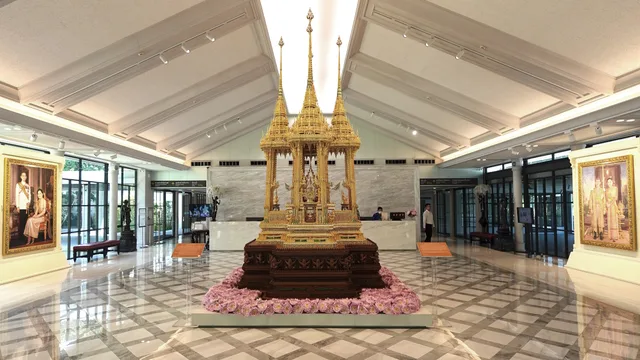
In the past, these works were displayed in Bangkok, in the Ananta Samakhom Throne Hall, under the title Arts of the Kingdom. In 2017, the throne hall closed for restoration. Part of the collection then moved to Koh Kerd. The museum that already stood on the site was renovated, and a new wing was built beside it. By the spring of 2020, the museum was in place.
The museum stands within the Koh Kerd Royal Craft Centre. The estate covers about two thousand rai, that is, some three hundred and twenty hectares of organically farmed land. The buildings are in Thai style. Gardens and courtyards separate them, and trees and waterways surround them. The new wing offers generous spaces, to display large objects such as thrones or model barges.
A large part of the collections is devoted to precious metals. Damascening, called khram, inlays gold or silver threads into metal to form a pattern. Niello, or thom, works differently: the metal is engraved, then the grooves are filled with a black alloy that makes the design stand out. Enamel lays vitrified colours on the metal. These arts traditionally served the court. Here, they are mastered by craftspeople from farming families.
The museum also presents humbler materials, worked to the same high standard. You will see wood carving, and inlay made from beetle wings, those hard, shiny wing cases with a metallic sheen. There is also embroidery and basketry, in climbing fern or bamboo. These rural techniques are presented as arts in their own right. Some pieces involved more than one hundred craftspeople over nearly four years.
Several masterpieces take up the forms of royal ceremony. The Phutthan throne, in gold niello, combines the most prestigious function with one of the most delicate techniques. Models represent the royal barges, which carried the king on the river during the great processions. The most famous is the model of the Si Suphannahong barge. Look out, too, for a gold box shaped like a mangosteen, set with diamonds.
Other works tell stories. An embroidered screen shows the Himavanta forest, the mythical forest of Buddhist cosmology, home to fabulous creatures. A large carved wooden screen combines this setting with the tale of Sang Thong, a prince hidden beneath a humble appearance. On the second floor, another embroidered screen illustrates Inao, a great drama of court literature.
The site also hosts khon, a masked dance drama of the court tradition, which stages the Ramakien, the Thai version of the Ramayana. A building is dedicated to it, and performances are sometimes held there. Masks, embroidered costumes and ornaments draw on the same crafts as the objects on display.
Remember the essentials: here, craftspeople from farming families master techniques once reserved for the court. The Arts of the Kingdom Museum brings together the land, the workshop and the stage, and shows a heritage that is still being created.
Photo : © Eric Monteil
Source: JARUK