
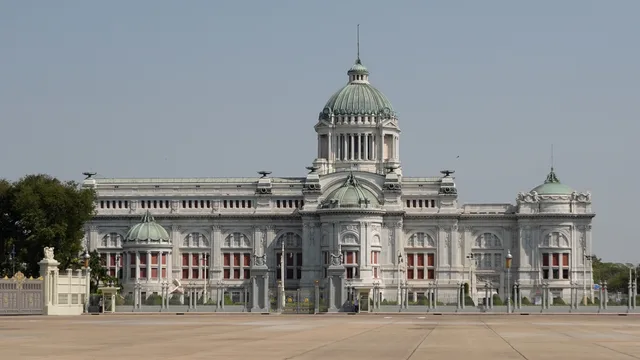
Ananta Samakhom Throne Hall
Dusit · BangkokWelcome to the Ananta Samakhom Throne Hall, the former reception hall of Dusit Palace, in Bangkok. King Chulalongkorn wanted it to represent Siam. It is the only marble throne hall in the country.
The building closes the vista of Ratchadamnoen Avenue. In front of it lies the Royal Plaza, with the equestrian statue of Chulalongkorn, the monarch who commissioned it. The hall belongs to a palace complex that is still home to the royal family.
The foundation stone is laid on the eleventh of November 1908, for the fortieth anniversary of the King's first coronation. The work is entrusted to an Italian team. The Turin architect Mario Tamagno designs the building, together with his fellow countryman Annibale Rigotti. Chulalongkorn dies in 1910, long before the work is finished. His son Vajiravudh, who becomes King Rama the Sixth, carries the project forward. The building is completed in 1915.
Look at the façade. It is clad in white Carrara marble, imported from Italy. Its style draws on the Renaissance and on Neoclassicism. A great central dome, about fifty metres high, towers over the whole. Six smaller domes surround it. Nothing here recalls the tiered roofs of traditional throne halls. The form comes from Europe, but the function remains that of a royal audience hall. It is said that the architect was inspired by St Peter's in Rome and St Paul's in London.
Inside, the throne stands beneath the central dome. Above it, the frescoes by the Florentine painter Galileo Chini and his assistants trace the history of the Chakri dynasty, from the first to the sixth reign. Chini studied Siamese ornament and the country's history so as to paint with accuracy. For one scene, he even studied the anatomy of the elephant.
In 1932, the hall takes on a new role. From the twenty-fourth to the twenty-seventh of June, during the four days of the revolution that ends absolute monarchy, it serves as the headquarters of the People's Party, the Khana Ratsadon. On the twenty-eighth of June, the first People's National Assembly meets here. On the tenth of December, King Prajadhipok grants the first permanent constitution here. Constitutional government is thus born in the most solemn setting of the monarchy.
The hall then becomes the seat of Parliament, until 1974. For more than forty years, members of parliament debate beneath Chini's dynastic decoration. After they leave, it remains the venue for the State Opening of Parliament. It also hosts the Arts of the Kingdom exhibition, devoted to the craft skills of the kingdom.
Since the first of October 2017, the hall has been closed to the public. It is undergoing works, and no reopening date has been announced. You can admire it from the outside. Its frescoes remain out of sight. A restored replica of a sketch by Chini is on display at the National Gallery in Bangkok.
Remember this: Ananta Samakhom is both a throne hall built by Italians for a king of Siam, and the place where Thai constitutional government was born.
Photo : © Eric Monteil
Source: JARUK